



GEO visibility grows when a brand appears as a consistent, verifiable and relevant player across its website, third-party sources and platforms.
Companies reach their target group in LLMs and AI Overviews before a click happens.
They can appear in answers, be used as a source or be present in comparison and decision situations that used to be shaped mainly by classic search results pages.
This takes more than good content on the company website. Generative systems orient themselves by mentions, citations and links.
They check which statements recur, which sources confirm them, which platforms shape a topic and which signals point to real relevance.
Together, this creates an offsite GEO network that turns visibility in LLMs into inquiries and leads.
This article shows which sources matter, how website, third-party sources and platforms work together and how to structure the build-up of AI brand mentions.
AI search works differently from a classic search results page. The position of a URL is only part of the picture.
Generative systems create answers from sources, context, entities, recurring statements and evidence.
A brand can be named in an answer without its website appearing as a source. At the same time, a website can be cited without the brand featuring prominently in the answer text.
GEO visibility therefore needs a source landscape that represents the company clearly, diversely and with topical relevance. The website delivers the canonical statement.
External sources confirm this statement outside the company’s own domain. Together, they form a pattern that LLMs and AI Overviews can recognize, verify and use in answers.
How the shift from ranking to reference works is described in detail in LLM SEO: From Ranking to Reference.
| Level | Definition | Controllable | Role in the process |
|---|---|---|---|
| Brand mention (input) | Mention of the brand, person or service in a third-party source on the web, with or without a link | Yes, via PR, outreach, platform profiles, reviews, partner sites | Action |
| Backlink (input) | Link from an external website to the company’s own page | Yes, via link building, content partnerships, digital PR | Action |
| Owned asset (input) | Citable content on the company’s own domain | Yes, fully | Action |
| AI mention (output) | Brand named in the text of an AI answer | No, only influenceable | KPI |
| AI citation (output) | Source that supports the AI answer and is shown as a link or footnote | No, only influenceable | KPI |
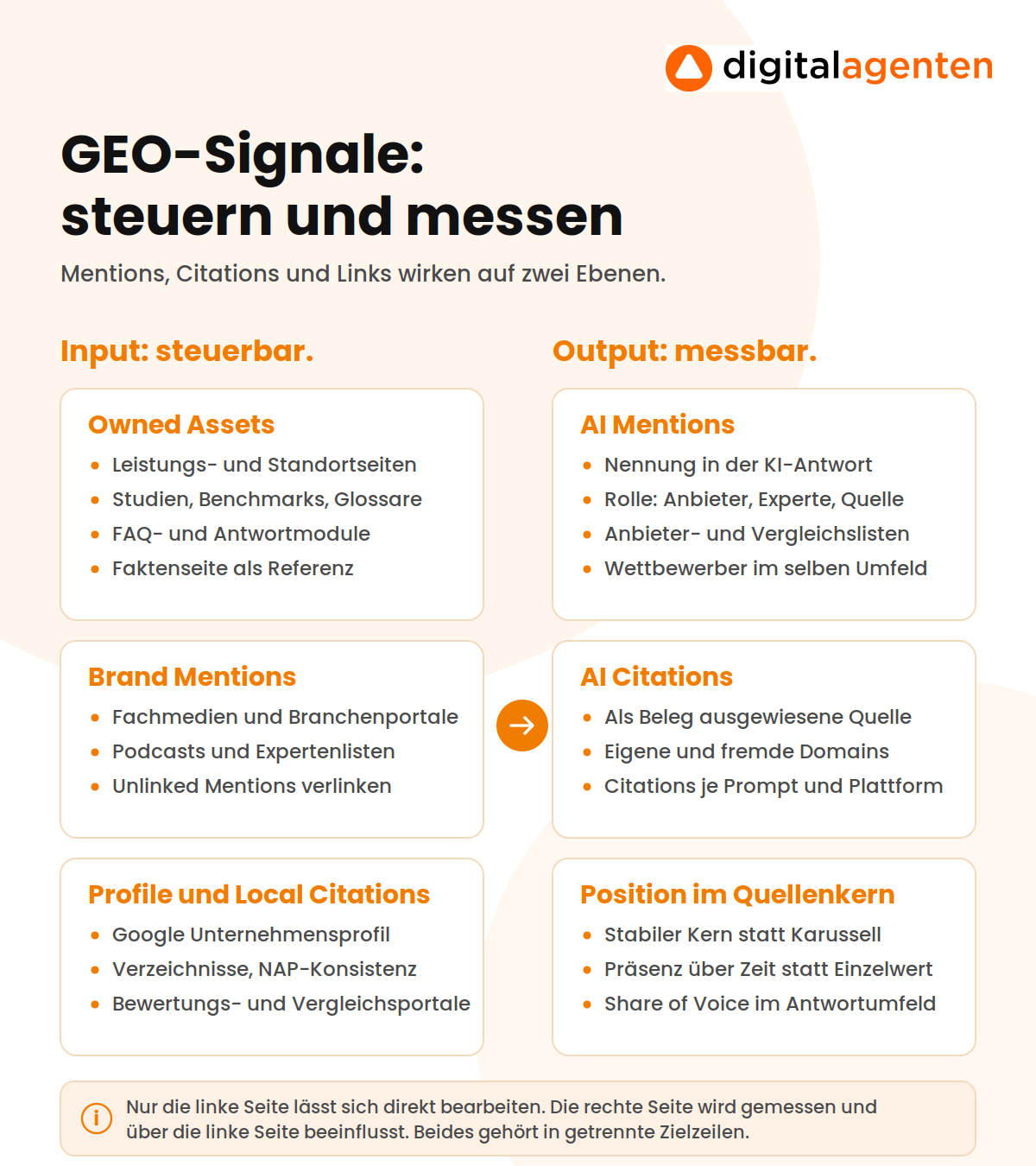
On the output side, a mention is the naming of a brand, person, service, platform or source in an AI answer. It shows whether a system considers a brand in a topic area at all.
Appearances in vendor lists, comparison answers, expert assessments and pre-purchase questions matter most. A brand can be named there without its website being linked or cited.
Mentions are therefore an early visibility signal. They show whether a brand appears in the answer context and in which role: as a provider, expert, data source, method, platform or example.
On the input side, mention means something else: the mention of the brand in a third-party source. These mentions are the raw material from which systems later form their image of the brand, and they are fully controllable.
A special case is unlinked mentions, meaning mentions without a link. Teams can identify them with little effort and turn them into linked mentions.
In the GEO context, a citation is the source that supports a generative answer. It can be the company’s own URL or an external source such as an expert article, an industry portal, a study, a review profile or a platform post.
Citations connect a statement with concrete evidence. For GEO visibility, it matters whether a brand is named and also which source the system uses to support the statement.
Citable sources have a clear structure, recognizable entities, current information, topical fit and easily extractable answer blocks.
The technical requirements are described under structured data for GEO and AI SEO.
| Term | Meaning | Typical examples | Controllability |
|---|---|---|---|
| Local citation | Entry of company and location data in a directory or portal, classically as NAP data with name, address and phone number | Google Business Profile, Apple Business Connect, Bing Places, business directories, review portals | Directly controllable, centrally manageable |
| AI citation | Source reference that an AI system shows to support an answer | Linked source below an AI Overview, footnote in ChatGPT Search, cited domain in Perplexity | Not directly controllable, only influenceable via the input side |
Links remain a core part of offsite work. They strengthen findability and authority and bring users and crawlers to the company website.
For GEO, a link alone is not enough. It becomes valuable when the linking source is topically relevant, appears in the target group’s research path and is recognized by generative systems as reliable context.
A link from a suitable trade medium, industry portal or review environment therefore has more impact than many weak links from generic sources.
The same applies to mentions without a link, because they shape brand understanding in generative answers in the same way. The classic side of this work is described under offpage optimization.
Owned sources are all sources that a company controls itself. These include:
These sources deliver the canonical statement about the brand. They define which services are offered, which terms matter, which methods are used and which evidence supports the company’s expertise.
For GEO visibility, owned sources must be clearly structured, up to date and citable.
A compact facts page that all other content refers to significantly reduces maintenance effort, because key information is updated in one place only.
A GEO audit checks whether the company’s own pages meet these requirements, from structure and freshness to structured data and extractable answer blocks.
Earned sources are external sources in which a brand is mentioned, described or rated independently. These include:
They show generative systems that others talk about the brand, too. Earned sources are particularly valuable when they classify the brand concretely: as a provider, expert, data source, study author, project partner, method or best-practice example.
The closer the source is to the topic and the target group, the more strongly it supports the brand image.
Platform sources are large digital environments that generative systems use to varying degrees depending on the topic.
These include YouTube, Reddit, LinkedIn, Wikipedia, Quora, G2, Capterra, TrustRadius, business directories, review portals and social profiles.
These platforms shape the context from which AI answers emerge. An explainer video, a LinkedIn profile, a review profile or a community discussion assigns a brand to a topic, a target group or a decision situation.
Evaluate platforms by whether they appear in the answers and research paths of the target group, instead of covering them across the board.
A B2B brand benefits more from LinkedIn, trade portals, podcasts and software directories.
A brand with many locations needs Google Business Profiles, review platforms, business directories, local media and consistent location data.
Three phases structure the build-up of visibility in AI answers. A rating by effort and time to impact for each task determines order and budget.
Effort: low means up to one person-day per unit, medium means one to five person-days, high means more than five person-days or ongoing operation.
Time to impact: short means two to six weeks, medium means one to three months, long means three months or more.
An opportunity analysis adds the value to this rating: it converts untapped demand in search and AI answers into leads and revenue and shows where budget has the greatest impact.
| Task | Effort | Time to impact |
|---|---|---|
| Define and cluster target group prompts | medium | short |
| Select relevant AI platforms | low | short |
| Establish a baseline for mentions, citations and links | medium | short |
| Identify competitors in answers | medium | short |
| Determine the industry-specific source set | medium | medium |
| Inventory existing owned assets | medium | short |
| Record existing third-party sources and profiles | low | short |
| Task | Effort | Time to impact |
|---|---|---|
| Correct and complete profiles on relevant platforms | low | short |
| Record unlinked mentions and turn them into linked mentions | low | short |
| Structure existing pages more clearly and make them extractable | medium | medium |
| Review and activate review and rating sources | medium | medium |
| Close the most important content gaps | high | medium |
| Create citable assets such as studies, benchmarks, glossaries | high | long |
| Define and prioritize first outreach targets | medium | medium |
| Task | Effort | Time to impact |
|---|---|---|
| Expand platform profiles and keep them up to date | low | short |
| Measure new citations and mentions | low | short |
| Place expert quotes | medium | medium |
| Approach trade sources and partner sites | medium | medium |
| Set up targeted pitches | high | medium |
| Distribute data assets | high | long |
| Evaluate changes in share of voice | medium | long |
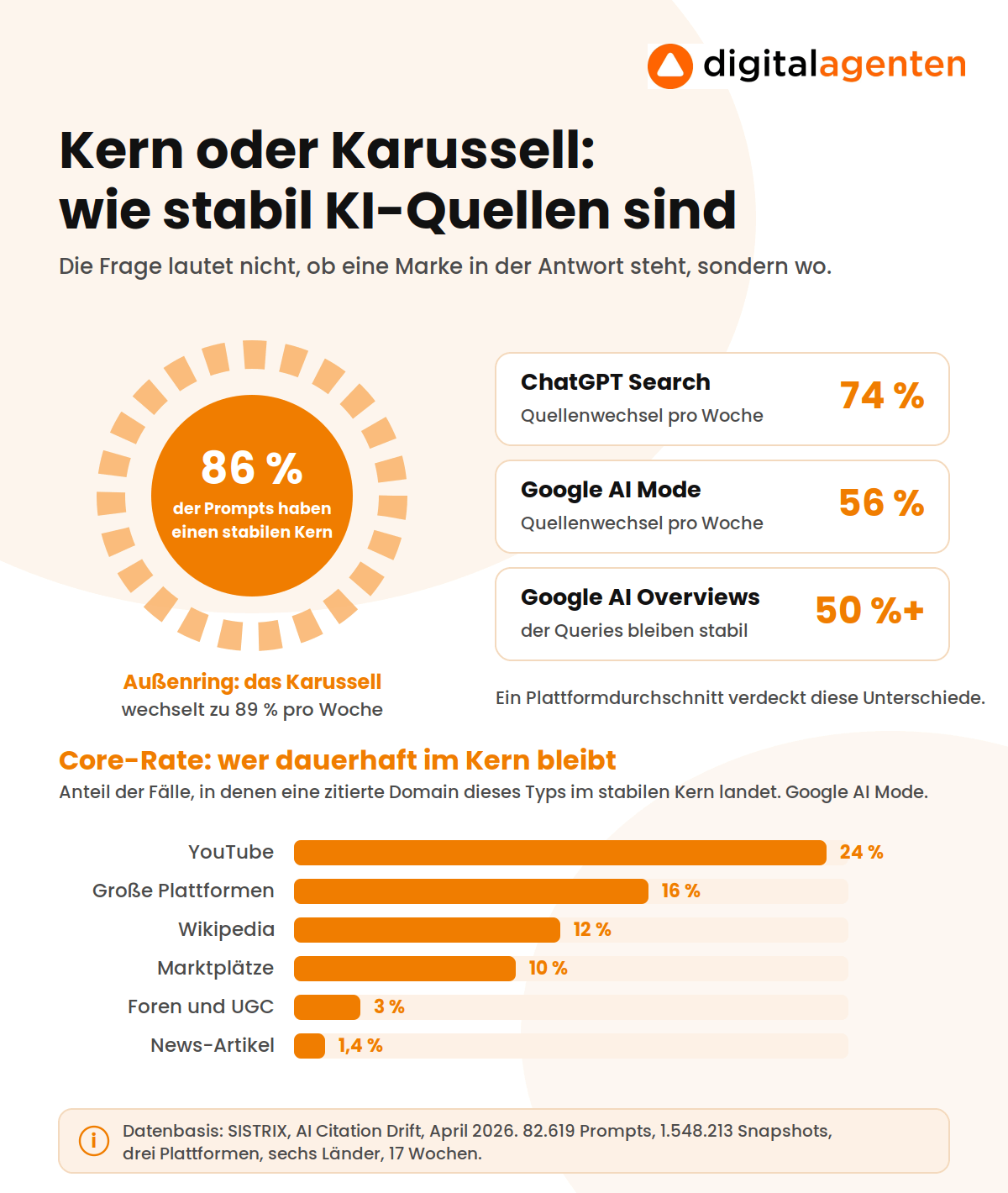
The operational question is therefore whether a brand sits in the stable core or in the rotating carousel. A single citation is a snapshot, not a reproducible result.
Success metrics should therefore be based on presence over time instead of individual measurements. For managing stakeholder expectations, this means: GEO is an ongoing process with recurring optimization.
Source: SISTRIX, AI Citation Drift, April 2026.
A blanket prioritization of GEO sources does not work. A software company needs different sources than a financial services provider, an automotive company or a company with many locations.
The platform also matters, because ChatGPT, Gemini, Perplexity, Google AI Mode and Google AI Overviews do not draw on the same sources to the same extent.
Source work therefore starts with two questions:
Every industry has a recurring set of sources that generative systems draw on particularly often.
In software, these are often comparison and review platforms such as G2, Capterra or TrustRadius as well as editorial vendor lists. For finance topics, by contrast, trade portals and comparison sites appear frequently.
In travel, review platforms play a bigger role. In automotive, vehicle marketplaces and trade media are relevant.
For business and professional services, LinkedIn, business directories, review sites and trade media carry more weight.
For every company, and sometimes for every single service, it is worth checking which sources actually appear in AI answers in the topic area, which competitors appear there and which owned content or mentions are missing. This results in typical actions per source:
| Source type | Impact | Effort | Core rate | Use |
|---|---|---|---|---|
| YouTube | high | medium | 24 percent | AI Overviews, tutorials, explainer topics, product context |
| Large platforms and tech providers | high | medium | 16 percent | category fit, reach |
| Wikipedia and Wikidata | very high, but only with real relevance | very high | 12 percent | entity understanding, cannot be forced in the short term |
| Marketplaces | medium to high | medium | 10 percent | product context, availability |
| Reddit and communities | high, strongly topic-dependent | medium | 3 percent | community signals, real questions, ChatGPT context |
| Press and news | high in the short term, rarely lasting | high | 1.4 percent | awareness and authority, unsuitable for stable citations |
| Owned citable guides, studies and glossaries | very high | medium to high | not measured | owned basis, AI citations, internal linking |
| Trade portals and industry media | very high | high | not measured | earned trust, expert status, B2B relevance |
| Comparison and review platforms | high | medium | not measured | vendor research, social proof, category fit |
| high for B2B | low to medium | not measured | personal brand, expertise, trust, distribution | |
| Podcasts, interviews and webinars | medium to high | medium | not measured | expert positioning, earned mentions |
| Business directories and listings | medium, high in a local context | low to medium | not measured | base profile, data consistency, trust |
| Partner and integration pages | medium to high | low to medium | not measured | B2B trust, topical proximity |
| System | Frequently relevant sources |
|---|---|
| ChatGPT | Reddit, Wikipedia, community posts, trade sources, comparison sites, well-structured websites |
| Google AI Overviews | YouTube, classic Google search results, well-structured websites, trade portals, Wikipedia, Reddit |
| Google AI Mode | Google-related sources, YouTube, social profiles, local sources, review platforms, Google Business Profiles |
| Gemini | Google-related sources, Wikipedia, YouTube, Reddit, publishers, structured websites |
| Perplexity | expert articles, studies, comparison sites, review platforms, third-party sources, communities, data-rich websites |
| Claude | authoritative third-party sources, long-form articles, studies, documentation, trade sources |
On May 27, 2026, Google extended the Preferred Sources feature to AI Overviews and AI Mode. Users select websites in their search settings that they prefer to see.
These sources receive a visible label in AI answers and, according to Google, are shown more often when the query fits and current content on the topic exists. According to Google, users click preferred sources about twice as often.
The lever is unusual because it lies outside the ranking logic. Readers set it actively.
For companies with a recurring readership, for example via a newsletter or expert blog, this creates a concrete task: motivate existing contacts to select the company domain.
Source: Google announcement of May 27, 2026.
The same GEO logic applies to companies with multiple locations, but it works with local entities.
Besides brand, service and topic, locations, opening hours, reviews, business directories, local media and location pages take center stage.
Projects in insurance, automotive and health, with networks ranging from half a dozen locations to five-digit numbers spread across up to double-digit numbers of countries, show recurring patterns. They apply across industries and largely regardless of network size.
Location pages that differ only by inserted place names are hardly distinguishable for generative systems.
Real local differentiation comes from location-specific services, teams, opening hours, directions, local partnerships and individual reviews.
The effort per location is higher, but the approach can be transferred to the entire network.
The build-up continues after the first citation. What matters is whether the sources appear in relevant AI answers, whether they are used as evidence and whether they create a stable brand image together.
For LLMs and AI Overviews, further questions need answers beyond classic SEO data:
Mentions and citations are leading indicators. Brand search, direct traffic and leads are later business signals.
Which KPIs make reporting convincing for budget owners and how to prove impact before the click is described in detail in the article on GEO and SEO reporting 2026.
Prompt tracking translates the customer journey into concrete questions. It checks which brands are named, which sources are cited and which platforms shape a topic. Typical prompt groups are:
Because of citation drift, a one-time measurement has little meaning. A recurring survey at fixed intervals makes presence over time visible.
Prompt tracking delivers the raw data. Analysis tools organize it and show which sources already work, which gaps exist and which tasks follow for content, offsite, PR, platform profiles and reporting.
The single AI visibility score has limited value. A tool becomes useful when it answers the questions above: brand perception, fact consistency, topics and roles, owned and third-party sources, competitive environment, source gaps versus competitors, content opportunities from prompt research and open questions of the target group.
No tool covers the entire task. The choice depends on the use case, for example AI visibility, SEO data, backlink analysis, prompt tracking, local tracking, competitor or source analysis and reporting.
| Tool | Typical use |
|---|---|
| SISTRIX | SEO data, AI and chatbot analyses, AI deep dives, visibility and competitor data |
| Rankscale | AI visibility and LLM monitoring |
| Peec AI | AI search analytics, prompt tracking, AI visibility monitoring |
| Semrush | AI visibility, SEO data, competitor analysis, keyword and backlink data |
| Ahrefs | backlinks, Content Explorer, competitor and SEO analyses |
| Yext Scout | local and AI search context for locations and listings |
| Local Falcon | local rank tracking and map visibility |
| Whitespark | local search, citations, local ranking factors and citation research |
Mentions, citations and links work best when they are planned together. The build-up starts with a clear source logic, before more content.
The company website provides the canonical basis. Earned sources confirm expertise and topical relevance outside the company’s own domain.
Platforms such as YouTube, LinkedIn, Reddit, review portals or business directories complete the context in which AI systems form answers and select sources.
At the same time, this work supports classic SEO goals. Citable owned assets improve internal linking and strengthen topical depth.
Relevant third-party sources, high-quality links and consistent mentions increase authority and findability. Both channels benefit from clear entities, reliable sources, structured content and external confirmation.
digitalagenten analyzes which mentions, citations and links already strengthen your brand and which sources bring more GEO visibility.
The result is a plan for building relevant sources: from prompt tracking and source analysis to owned asset audits and source prioritization to outreach, link building, platform profiles and ongoing monitoring.
For companies with many locations, managing the local source landscape is added, from data consistency to listings and review building.
We set up the collaboration modularly or holistically. Depending on the starting point, digitalagenten supports analysis, planning, build-up and optimization of individual building blocks or the entire GEO and SEO process.
A local citation is an entry of company and location data in a directory or portal, classically as NAP data with name, address and phone number. It is directly controllable and centrally manageable.
An AI citation is the source reference that an AI system shows to support an answer. It is not directly controllable.
Well-maintained local citations increase the likelihood that a location appears correctly in local AI answers, but they are not AI citations themselves.
Earned sources confirm a brand outside its own website. These include trade media, industry portals, podcasts, partner sites, review platforms, expert lists and community posts.
They show generative systems that others talk about the brand, too. External confirmation helps classify a brand as a provider, expert, data source, method or best-practice example.
YouTube is particularly relevant for explainer topics, tutorials, product context and AI Overviews.
In the SISTRIX analysis, YouTube reaches the highest measured core rate at 24 percent, so it most often lands permanently in the stable source core.
Reddit reflects community questions, experience and discussions, but forums and user-generated content reach a core rate of only 3 percent. LinkedIn is important for B2B expertise, personal brands and trust signals.
Evaluate each platform by whether it appears in relevant AI answers and decision situations of the target group.
Measure AI visibility beyond direct referral traffic from AI tools, because visibility already has an effect before the click.
Useful measurement dimensions are mentions by platform, citations by domain and URL, share of presence in the stable source core, links by source and quality, share of voice, sentiment, competitors in the same answer environment, brand search, direct traffic and leads with an AI touchpoint.
Local SEO is a special case of the source strategy. Local entities are added here: locations, opening hours, reviews, location pages, local citations, business directories and Google Business Profiles.
The logic stays the same. Sources must be consistent, current and verifiable. For companies with many locations, it is decisive that website, profiles, listings, reviews and local data describe the same reality.
An offsite GEO audit starts with relevant prompts from the customer journey. It checks which brands are named, which sources are cited, which competitors appear and which platforms shape the answers.
This is followed by determining the industry-specific source set, analyzing competitor sources, an owned asset audit, a backlink and mention analysis and tracking of the most important GEO signals.
The result is a prioritized roadmap for mentions, citations, links, platform profiles and outreach.
Online Marketing Agency Berlin » AI Brand Mentions, Citations and Links: Building GEO Visibility

Lorenz Wacker is Managing Partner and Digital Strategist at digitalagenten Berlin and specializes in comprehensive digital strategy.
As managing director, he brings deep expertise and a visionary approach to designing digital multichannel strategies.
Lorenz has extensive industry experience in automotive, financial services, insurance, online media, telecommunications, retail, travel and healthcare.
You are currently viewing a placeholder content from Vimeo. To access the actual content, click the button below. Please note that doing so will share data with third-party providers.
More InformationYou are currently viewing a placeholder content from YouTube. To access the actual content, click the button below. Please note that doing so will share data with third-party providers.
More InformationYou need to load content from reCAPTCHA to submit the form. Please note that doing so will share data with third-party providers.
More InformationYou are currently viewing a placeholder content from Facebook. To access the actual content, click the button below. Please note that doing so will share data with third-party providers.
More InformationYou are currently viewing a placeholder content from Instagram. To access the actual content, click the button below. Please note that doing so will share data with third-party providers.
More Information