The more locations a company has, the greater its potential for local visibility, leads and revenue. To roll out this growth across all locations with a limited budget, a central architecture is needed. It decouples the number of locations from the effort for maintenance and rollout.
The biggest lever is bundling recurring tasks into solutions that can be implemented across many locations. These include standardized workflows, central control and tools for onsite and offsite SEO.
This builds classic search visibility and LLM-based visibility (GEO) together. Local SEO forms the foundation.
GEO completes visibility where more and more people search: in ChatGPT, Gemini, Claude, AI Overviews and similar systems.
For GEO, a second vector matters besides local anchoring: the topical and semantic vector. Local listings, location data and Google Business Profiles mainly strengthen the local vector.
Citations, mentions and topically relevant third-party sources strengthen the topical vector across all locations. For queries such as “best car dealership for small cars in Berlin”, both vectors work together.
This article shows how to build such a setup in practice.
It translates the six key ranking levers according to Whitespark (SEO) and Zyppy (GEO) into a scalable model for local SEO for multiple locations, with smart use of AI.
The classic approach (task by task, location by location) stops scaling beyond a certain size. It follows this equation:
Effort per location × number of locations = linearly growing total effort
Growth remains possible with limited resources when recurring tasks no longer have to be solved again for each location.
The smart approach shifts the operational focus to a central visibility strategy and infrastructure:
1 central strategy × scalable systems / tools × number of locations = decreasing effort per location
Analyses by Whitespark for classic local SEO and studies by Zyppy for generative engine optimization (GEO) define clear ranking factors for search engines and LLMs.
The overlap of this data delivers six primary visibility levers. Their effects overlap, they come with specific requirements for AI systems and they share one key property: companies can control them directly.
GEO relies on the same basis: 38 percent of the top 10 search results are cited in LLMs. Pages must be accessible, crawlable and clearly readable.
JavaScript-heavy setups, inaccessible content or technically blocked areas limit access.
The same applies to preview signals: content that search engines and AI systems cannot capture cleanly or use as a snippet is cited less often as a source.
A GEO audit shows whether location pages are accessible and readable for search engines and AI crawlers. It checks crawlability, rendering and snippet signals per page type.
Good location pages answer the main keyword and also obvious follow-up questions, either directly or via internal links.
This expands the topical depth of the page and increases the chance of being cited as a suitable source in classic search and in LLM answers.
In practice: a landing page for a car dealership in Nuremberg should cover more than “car dealership Nuremberg”.
It should also answer concrete follow-up questions, for example about workshop service, test drives, leasing, opening hours or the regional service area.
For many locations, structured data creates a uniform, machine-readable basis for services, contact details, opening hours and other location information.
For multi-location setups, the practical lever lies in standardized JSON-LD blocks for each page type (see templates / information architecture). They are defined once and then only adapted to each location.
Key schema types are LocalBusiness, suitable subtypes such as AutoDealer or AutomotiveBusiness, plus Organization, PostalAddress, OpeningHoursSpecification, Service, BreadcrumbList and, depending on the page type, FAQPage.
Grounding pages bundle the most important information about location, service, responsibility and trust signals in one place. They help LLMs in particular to refer to the company more accurately and more often. The content is written in natural language in Wikipedia style.
For multi-location setups, this principle can be standardized: first, a fixed template with categories is created, for example company data, services, scope and more. Then the content is adapted for each location.
Local service references, unambiguous entities and consistent terms improve compatibility with GEO. Grounding pages also strengthen internal linking.
Large location networks need uniform performance standards that can be implemented across many pages and templates, for example for loading media, assets and template performance.
Cloudflare can provide technical support here to load content faster, more reliably and more efficiently.
Requirements for load times, Core Web Vitals and technical quality complete the setup. New pages and templates then go live quickly and keep this level throughout the rollout.
Cloudflare can easily block relevant AI crawlers if the setup is configured too restrictively.
The configuration must therefore be calibrated carefully: malicious bots are blocked, while relevant LLM crawlers for grounding and URL accessibility must get through.
In many local search situations, the Google Business Profile is the most visible entry and supports both GEO vectors (mainly local, but also topical). For locations, it is therefore more than a single listing.
It is the central, verified entity of a location and often also the most important review platform.
This building block is just as decisive for GEO: a well-maintained, consistent profile delivers clear facts about location, service, opening hours, responsibility and contact.
Combined with landing pages, listings and other sources, this creates a “picture” that LLMs frequently cite.
For visibility, consistency and findability in the Google Business Profile, categories, services, core data, content and images are most relevant.
Primary and additional categories are defined once and then used consistently across all locations. A look at competitors helps to classify categories and the range of services realistically.
A local benchmark shows per location which categories, services and reviews the strongest competitors nearby have. Realistic targets per profile follow from it.
In addition, the service areas are maintained in a structured way and aligned with the content of the local landing pages.
These elements are set up consistently. NAP data (name, address, phone number), opening hours and other core data are defined centrally and published locally.
Image standards, post formats and content blocks can also be prepared for reuse across many locations.
This keeps the relevant profile fields complete and directly strengthens visibility in Google Maps, the local pack and along the conversion paths.
For GEO, consistency and factual accuracy count most. The clearer and more concrete the profile information, the better it can be matched with other sources and classified as a trustworthy ranking signal.
Profiles are rolled out and updated based on centrally defined standards, without manual maintenance of each profile.
API and bulk logic make this work easier. Content, opening hours, attributes and core data can be published efficiently for many locations at once.
In addition, approval and review paths ensure that changes go live in a controlled and brand-compliant way.
The practical advantage is obvious:
The Google Business Profile unfolds its impact in synergy with the local landing page, reviews and other location signals (especially local listings).
For generative systems, this connection matters twice: the better profile content, landing page, listings and reviews match, the easier AI can verify this information.
The synergy effect arises when all building blocks support the same facts and contribute to the same local search and answer patterns.
Local listings are entries in directories, maps, industry portals and other data hubs where a company’s location information appears.
For multi-location setups, they are above all a matter of consistency: name, address, phone number, opening hours and other core data should match across all relevant sources.
In a multi-location setup, local listings mainly affect the local vector. They confirm that a location exists at a specific place, is reachable and is managed with consistent data.
This is exactly what matters for queries with a strong local reference, such as “car dealership Berlin” or “auto repair shop in Nuremberg”.
The more closely name, address, phone number, opening hours and other location data match across the relevant directories, the clearer the local signal becomes for generative systems.
These systems draw on the company website and on third-party sources. What counts is the right sources for industry, location and search context, beyond the sheer number of mentions.
This makes it more likely that the landing page itself is cited. At the same time, the local listing can also appear as a source that in turn points to the brand.
Location data can be published from a central database to many directories at once and kept consistently up to date there. Yext and comparable systems are designed for exactly this.
They keep name, address, phone number, opening hours and other core data up to date across the most popular platforms, such as Google, Apple Maps and Bing.
For the rollout, this means:
Beyond the major platforms, a targeted expansion into industry-specific and local directories pays off, especially those that classic local listing tools do not cover. In practice, this means:
These listings are especially important for GEO: specialized listings and topically relevant data hubs often have a stronger effect than general business directories.
They deliver clear signals for topical classification and strengthen visibility in the respective cluster.
Presence then emerges where target groups actually compare, filter and build trust, which increasingly happens in LLMs.
As the number of locations grows, legacy issues often grow along with visibility and reach.
Duplicate profiles, outdated addresses, old phone numbers, inconsistent company names or inactive entries often remain online for years and weaken rankings.
Multi-location setups therefore need a clean-up process. With the Google Cleaner, contradictory entries and data can be identified and removed.
Generative systems compare information from multiple sources. The cleaner and more unambiguous these facts are, the more trustworthy and convincing the location becomes for LLMs.
Data hygiene therefore belongs in the ongoing rollout, right from the start.
Review volume, recency, content and platform diversity shape how relevant and credible a location appears.
Good review structures support conversion and local visibility. They also increase compatibility with generative systems, which makes them essential.
In 2026, Whitespark weights reviews more heavily than before and additionally considers third-party ratings and the authority of external review sites for AI search visibility.
Reviews should be monitored on all relevant platforms, beyond Google.
Besides Google, these include Trustpilot, ProvenExpert and industry-specific portals where target groups actively compare and build trust.
Ongoing operations need a central hub for this. Reviews from all locations are bundled in one dashboard, without checking each platform manually. This creates a clear overview of:
Good reviews on several relevant platforms increase a location’s credibility. This strengthens its topical classification within the respective cluster (topic cluster ranking).
One reason: reviews naturally contain relevant keywords and at the same time act as user-generated content for citations, which receive particularly high trust.
Many locations need a clear process between headquarters, regional managers and individual branches.
Monitoring, responses, escalation and approval are clearly defined. Standard cases are handled quickly and sensitive cases with care.
A robust setup mainly includes:
Recurring response patterns can be prepared and adapted per location. This shortens response times and keeps communication consistent across many locations.
In practice, the following matter most:
For GEO, the content of these responses matters. LLMs evaluate the review itself and also the company’s response as a text source. Standard phrases add little value there.
Responses should therefore stay specific within the template and clearly name services, location reference or the facts of the case.
This creates additional information that is useful for users and can also be used as content by LLMs.
Platforms, communities and their content increasingly become sources for LLMs. Presence matters most on platforms that carry real weight for the industry, location and search context.
Across several recent analyses, Reddit, YouTube, LinkedIn and Wikipedia are among the sources and domains most frequently cited in AI answers.
Not every platform contributes equally to local visibility and generative compatibility.
A simple classification helps as a first step:
Local budgets and activities should first go to the environments from which search engines and LLMs draw signals, citations and mentions particularly often. The fit with industry and location remains decisive. The most cited platform is not automatically the right platform.
Forum presence complements this: active monitoring and targeted brand placement in regional subreddits, city communities or specialist online forums. User-generated content also belongs in this area.
For GEO, this is relevant above all as a topic cluster signal. When real people discuss the service of a specific location on Reddit, an authentic external signal emerges.
These unfiltered opinions increase a location’s credibility in the respective topic and local context.
This can help a brand appear as a suitable solution for user prompts such as “Which car dealership in region X do you recommend?”
The same content logic applies to social media channels and video descriptions: clear information over pure advertising speak. For GEO, content with concrete and unambiguous facts is most relevant.
Examples include:
AI systems can extract such content more easily and use it as a citable source. This applies to YouTube descriptions as well as forum posts and social posts.
YouTube subtitles and transcripts can further strengthen this effect because they make the spoken content available in clearly readable form.
In a multi-location setup, links, mentions, citations and local listings are often lumped together. In operational work, however, they serve different functions.
This distinction is especially important for many locations, because not every external signal has the same leverage for local visibility, data consistency and GEO.
| Term | Definition | Main function in a multi-location setup | Example |
|---|---|---|---|
| Link | Clickable link to a target page | Strengthens authority, relevance and the matching location or service page | A local press article links to the service page of a car dealership in Cologne |
| Mention | Mere mention of a brand or location without a link | Strengthens topical and local context, especially in GEO-relevant environments | A forum names a car dealership in Stuttgart in connection with leasing offers |
| Citation | Mention of the location data or the brand in a relevant external context | Confirms location, data and local affiliation | Company name, address and phone number in a car community forum |
| Local listing | Specific entry of a location in a directory, map or platform system | Secures local presence and consistent location data on a platform | A complete entry on Yelp, Apple Maps or German directories such as Das Örtliche and Gelbe Seiten |
Today, citations are more than structured NAP data in directories. For multi-location companies, they also include editorial mentions, brand mentions and other external signals from topically relevant sources.
Relevant sources therefore go beyond Yext and classic directories such as Gelbe Seiten or Das Örtliche. They include specialist forums, leading local media, Wikipedia, digital PR and user-generated content.
Citations, mentions and topically relevant offsite signals mainly serve the topical and solution-related vector. They help LLMs classify a location by content as well as by region.
For queries such as “best car dealership for small cars in Berlin”, a local listing alone is therefore not enough. It needs mentions and sources that connect the brand with small cars, advice or selection.
Local listings answer the question “where?”, citations rather the question “for what?”. Visibility in GEO queries comes from both.
The authority of third-party sites further increases the value of unlinked mentions, because brands from topically strong and trustworthy sources appear more often in AI citations and generative answers.
In the context of AI answers, SISTRIX explicitly describes citations as clickable source references and distinguishes them from mentions as unlinked references.
At the same time, the analysis of the most cited pages shows that clear structure, authority and machine readability increase the chance of citations, exactly the factors discussed above.
Classic backlinks with an href attribute remain the strongest lever for domain authority and Google rankings. Topically relevant mentions and citations add to this by anchoring services, locations and brand in the right context.
Especially in specialist forums and local media, this can be considerably more valuable than presence in general business directories, which still matter as well.
User-generated content also belongs in this field when real users mention a location in a suitable topical or local context.
External signals that point to the right local landing pages, service pages or location profiles are particularly relevant.
Offsite signals are generated specifically by region, location type, service and topic cluster. They mainly include:
A proven model for this is grid tracking with tools such as Local Falcon. It shows how visible a location actually is in different parts of its service area.
This makes it measurable where a location is already strongly present and where gaps remain.
Local visibility varies by district, distance and search context.
To evaluate each location, several signals should be combined:
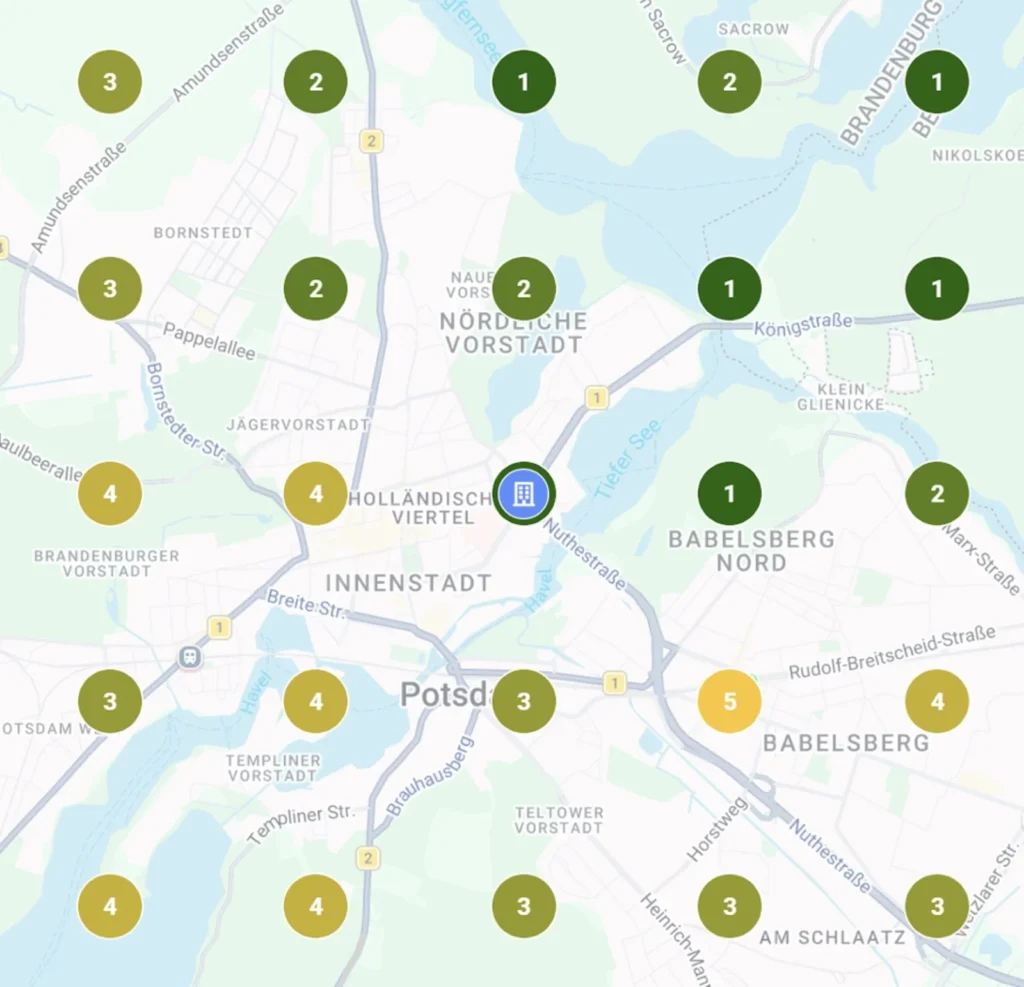
For GEO, tracking needs a second level. Beyond links, brand mentions, citations and share of voice in the environments that matter to generative systems are most relevant.
Besides classic SEO data, specialized tools and visibility analyses are used for this.
In a multi-location setup, all of this ideally comes together in a central dashboard. Automated reporting makes local performance comparable across all locations.
This simplifies prioritization, rollout and resource allocation, because it shows which location needs which lever next.
An opportunity analysis quantifies the untapped demand per location and channel and its value in leads and revenue. Budget then goes first where growth per dollar is highest.
For these requirements, digitalagenten provides suitable tools, workflows and scalable solutions that make many locations centrally manageable and more efficient in ongoing operations.
From plan to build to run, multi-location visibility needs a system that becomes more profitable as the number of locations grows. Standardized best-practice processes create the foundation.
They combine strategy, rollout, maintenance, quality assurance and ongoing optimization in one shared model.
Strategy, implementation and the right tools interlock and work as one system.
This turns many operational tasks into a setup that systematically expands local visibility and keeps it manageable in ongoing operations.
Not every location network needs the same measures. Some setups require a central strategy with a full rollout.
Others need individual building blocks, for example for landing pages, Google Business Profiles, listings, reviews, GEO or tracking.
That is why local SEO / GEO can be set up as a one-stop solution or modularly, depending on the starting point, internal resources and goals.
The result is a tailored solution that fits the company’s actual situation and grows with the location network.
Online Marketing Agency Berlin » Local SEO for Multiple Locations: Scaling GEO & SEO Visibility Across Every Location
You are currently viewing a placeholder content from Vimeo. To access the actual content, click the button below. Please note that doing so will share data with third-party providers.
More InformationYou are currently viewing a placeholder content from YouTube. To access the actual content, click the button below. Please note that doing so will share data with third-party providers.
More InformationYou need to load content from reCAPTCHA to submit the form. Please note that doing so will share data with third-party providers.
More InformationYou are currently viewing a placeholder content from Facebook. To access the actual content, click the button below. Please note that doing so will share data with third-party providers.
More InformationYou are currently viewing a placeholder content from Instagram. To access the actual content, click the button below. Please note that doing so will share data with third-party providers.
More Information