



AI is changing digital search at high speed.
In Germany, Google remains the most important access point to digital demand. At the same time, AI grows faster than any other digital channel analyzed.
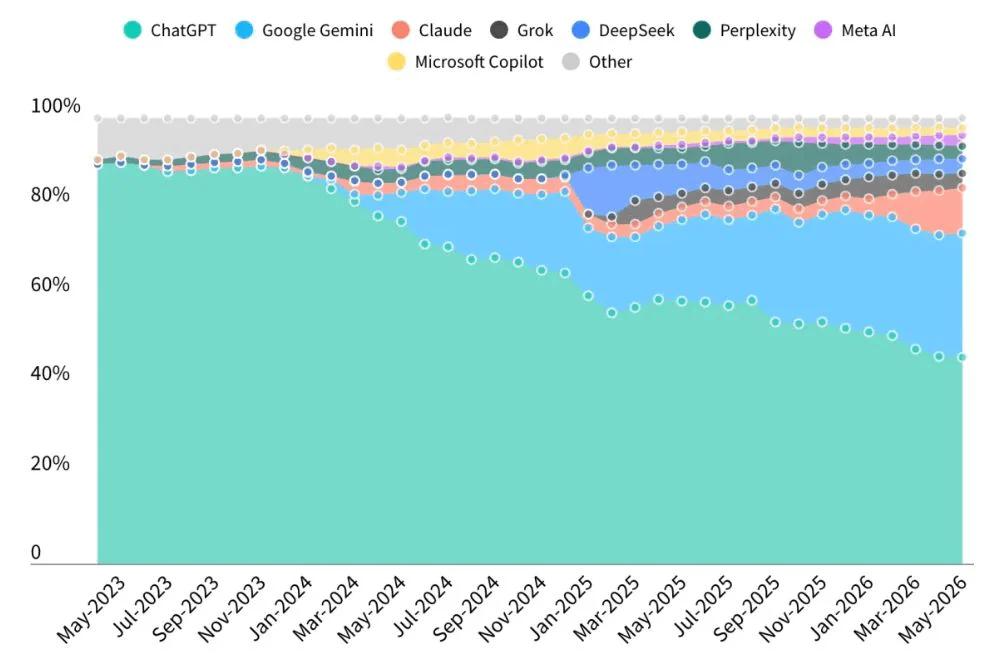
The AI market itself is shifting as well. ChatGPT stays large but loses market share. Gemini gains significantly. Claude matters more in professional contexts.
Other systems occupy roles of their own.
This article shows what this means for digital visibility. It combines two perspectives: internet usage in Germany and the LLM market share of the leading large language models.
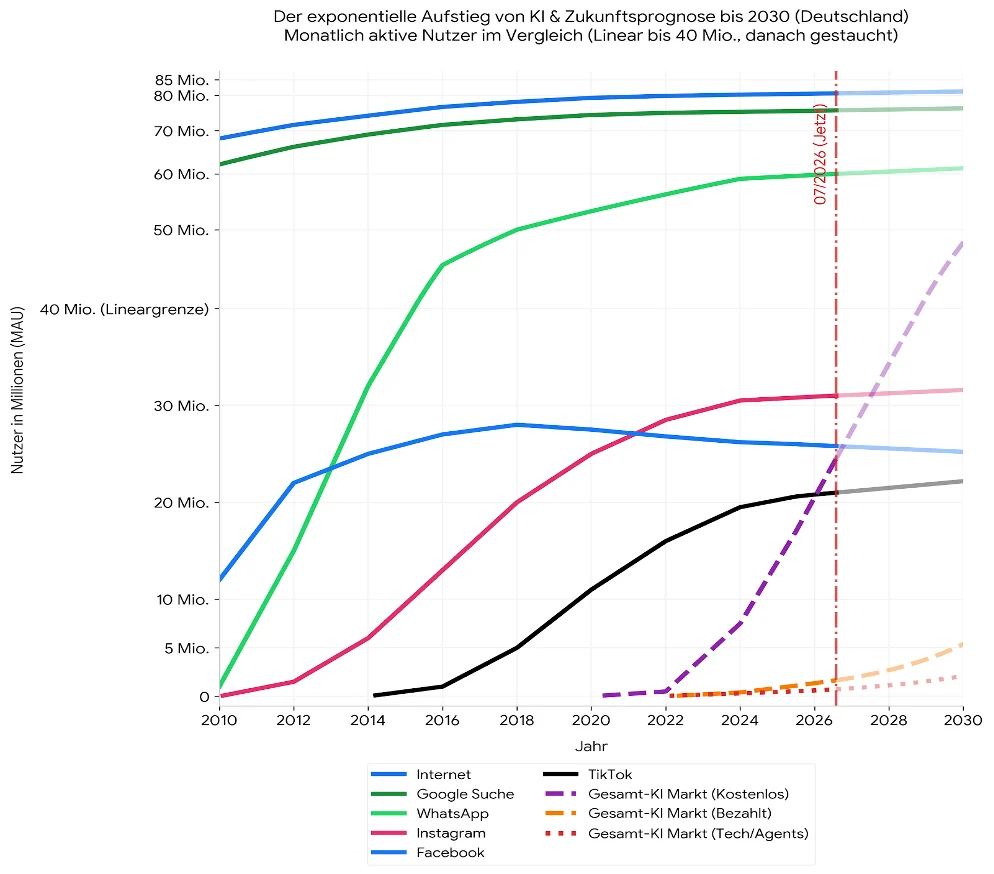
The strong rise in AI usage adds another layer of visibility to digital information search.
In the classic SEO view, the path was largely shaped by Google and the website:
Classic funnel
Need arises → Google search → results list → website click → vendor evaluation → inquiry
This path remains important. Google remains the central access point to existing demand. Social media, reviews and comparison content continue to shape decisions as well.
The main change: AI becomes part of everyday information search.
Users ask questions in AI chats, see AI Overviews in Google or receive summarized answers before they read up on a website.
Extended funnel
Need arises → Google, social media or AI → search result, AI answer, impression and first assessment → website or direct contact → inquiry
AI bundles information from various sources and delivers it as an answer on its own platform.
The target group more often sees AI answers, reviews, social media content or external mentions first, before visiting a website.
| Users | Behavior |
|---|---|
| 50 percent | use AI chats instead of classic search at least occasionally |
| 34 percent | use AI applications at least weekly |
| 15 percent | use AI daily |
| 24 percent | use AI less than once a week |
| 73 percent | rate results from AI chats as helpful |
The strong (projected) rise in the chart matches a behavior that has already started in Germany.
According to a Bitkom study, 81 percent of companies and 67 percent of the population regard AI as an important technology of the future.
Almost ⅓ of companies plan higher investments in AI technology than in the previous year (2025).
The website click does not disappear completely. It comes later or from an already pre-shaped information situation. Brands that become visible at this stage and shape the assessment positively are ahead of the benchmark.
The second chart by Philipp Klöckner shifts the focus from general internet usage to the composition of the AI market. It shows how the LLM market share of the leading systems has changed since 2023.
Perplexity stands for research-oriented search. The system is particularly relevant when users compare sources, evaluate vendors or want to understand complex topics quickly.
This mainly concerns B2B, consulting, software, finance, health, law, education and other fields where trust, evidence and expert assessment matter.
Microsoft Copilot extends search into the work and decision context. Depending on usage, the system can include web information, work data, files, emails, meetings, presentations or spreadsheets.
AI-powered information search therefore also takes place where decisions are prepared, documented and shared.
This becomes relevant above all for B2B, enterprise, SaaS, industry and professional services.
Grok is relevant mainly where search is close to real-time discourse, opinions and public debates. Through its proximity to X, Grok can pick up topics that develop through current posts, trends and discussions.
This particularly affects PR, media, tech, finance, entertainment, social debates and brands whose perception is strongly shaped by public discussion.
The AI market is growing in size and in functional breadth. For GEO, the goal is a clear focus instead of optimizing every tool individually.
What matters is understanding the relevant search intent of the target group and aligning content, sources, mentions and platform presence with it.
An opportunity analysis shows which channels and AI systems carry relevant demand for the target group and what this demand is worth in traffic, leads and revenue.
The broader distribution in the AI market has a second consequence:
AI visibility always has a context. AI systems draw on information created in many digital places: websites, search results, structured content, media reports, trade portals, reviews, social media content, forums and communities.
SEO provides findable, structured and thematically clear content. Social media creates attention, recognition and discussion.
Media, communities and review platforms provide external classification, mentions and context. Together, they also strengthen GEO.
A GEO audit checks the website part of this mix: whether content is crawlable for AI systems, clearly structured and usable as a source.
Google brings AI to market through far more than the Gemini app.
Philipp Klöckner describes this as a structural market advantage. In the consumer market, Google does not first need to build attention for a new app. Many users are already active in Google products every day.
AI can appear where people search, navigate, write, plan, watch videos or make decisions.
On top of this come several advantages that only few providers combine:
This is the source of Google’s strength in the consumer AI market. Other providers must actively lead users into their own apps, pro versions or new workflows. Google can embed AI into familiar everyday usage.
The data shows: search is getting broader, AI is growing into information search and visibility emerges on new channels.
digitalagenten helps you analyze and develop this visibility in a structured way: from classic Google visibility and local search to visibility in AI answers.
Depending on your needs, we work modularly on individual building blocks or holistically, from analysis and implementation to ongoing optimization.
Online Marketing Agency Berlin » Search Trends 2026: AI, Google, Social Media and the LLM Market Share

Lorenz Wacker is Managing Partner and Digital Strategist at digitalagenten Berlin and specializes in comprehensive digital strategy.
As managing director, he brings deep expertise and a visionary approach to designing digital multichannel strategies.
Lorenz has extensive industry experience in automotive, financial services, insurance, online media, telecommunications, retail, travel and healthcare.
You are currently viewing a placeholder content from Vimeo. To access the actual content, click the button below. Please note that doing so will share data with third-party providers.
More InformationYou are currently viewing a placeholder content from YouTube. To access the actual content, click the button below. Please note that doing so will share data with third-party providers.
More InformationYou need to load content from reCAPTCHA to submit the form. Please note that doing so will share data with third-party providers.
More InformationYou are currently viewing a placeholder content from Facebook. To access the actual content, click the button below. Please note that doing so will share data with third-party providers.
More InformationYou are currently viewing a placeholder content from Instagram. To access the actual content, click the button below. Please note that doing so will share data with third-party providers.
More Information