


GEO audit and SEO audit
The starting signal for monitoring and growth in Google and AI
The GEO and SEO audit by digitalagenten measures where your website stands today, in Google and in AI answers. After that, monthly monitoring measures every step up.
GEO audit and SEO audit in one: one data basis for Google and AI search
TL;DR
- The SEO audit checks whether Google finds, understands and ranks your website high.
- The GEO audit checks whether AI systems mention, cite and recommend your brand and website.
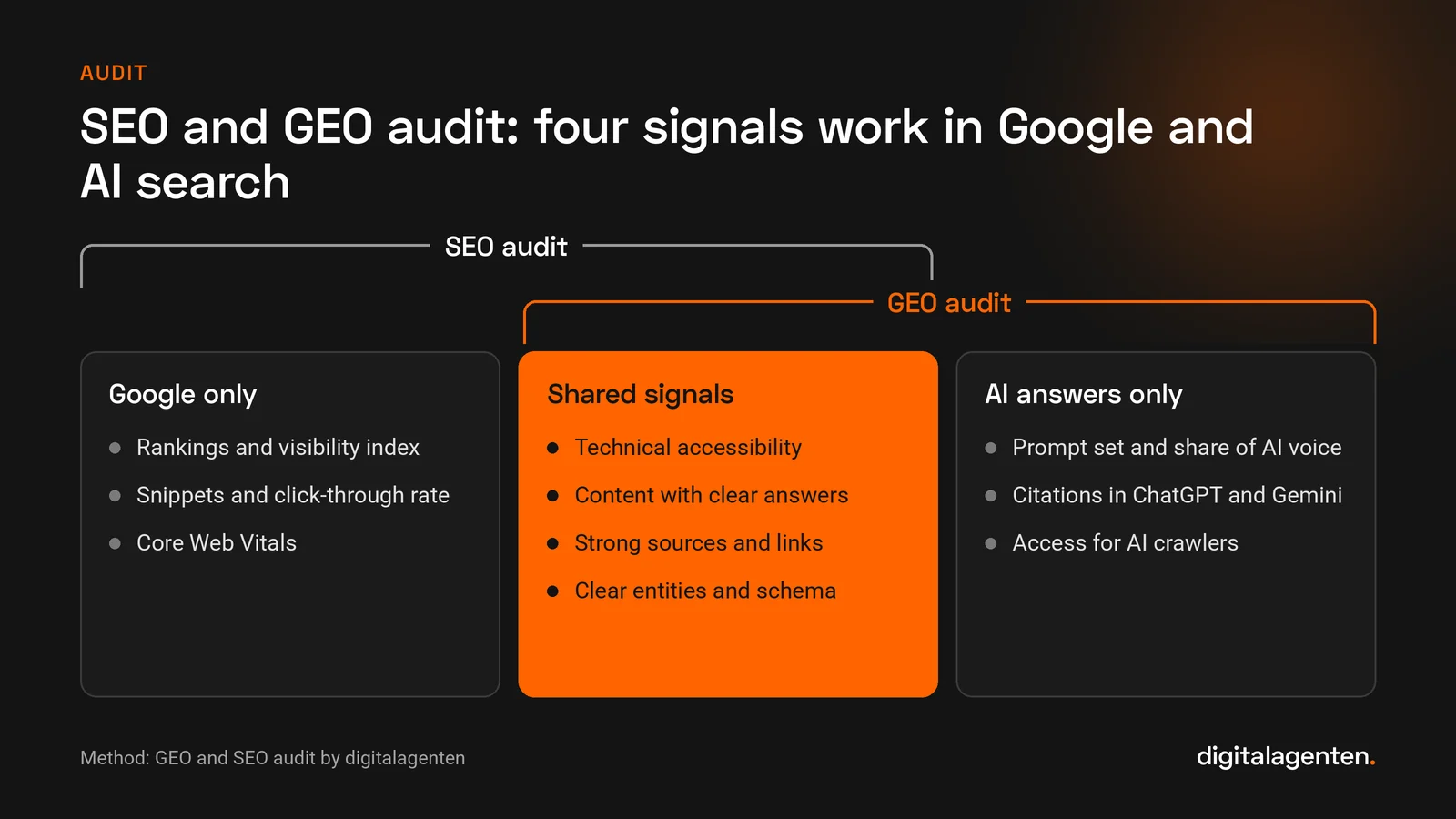
- Both depend on the same signals: tech, content, sources and entities. That is why digitalagenten checks both in one pass.
- The audit is the starting signal: after that, monthly monitoring measures every step up.
AI answers rely on pages that search engines capture well. An SEO audit without a GEO part leaves out the channel where customers now prepare decisions. The audit is the starting point of our online marketing consulting: the findings turn into a prioritized roadmap with tickets.
| Criterion | SEO check | SEO audit | GEO audit |
|---|---|---|---|
| Focus | Error list from a tool | Rankings, clicks and leads from Google | Mentions and recommendations in AI answers |
| Data sources | One crawler | Crawl, Search Console, log files, SISTRIX, Majestic | Prompt set, SISTRIX AI, Rankscale, source analysis |
| Assessment | Warnings without weighting | Findings by impact and effort | Share of AI voice compared to competitors |
| Result | Report | Roadmap with quick wins and tickets | Actions for content, entities and sources |
Building blocks of the SEO audit: tech, content, links and locations
Technical SEO audit: crawling, indexing, Core Web Vitals
Status codes, redirects, canonicals, hreflang, load time and JavaScript rendering. Identifies which technical problems keep Google from capturing your website correctly.
On-page and content audit: search intent, keywords, internal linking
Topic coverage per page type, titles, headings and keyword cannibalization. Identifies which content is missing, duplicated or doesn’t match the search.
Off-page audit: backlinks and mentions
Link profile, referring domains and risks compared to competitors. Identifies which sources bring authority.
Local SEO audit for one or many locations
Business profiles, NAP data, reviews and location pages. Identifies which branches are missing from the local pack.
Building blocks of the GEO audit: mentions, sources and entities in AI answers
Generative engine optimization (GEO) makes sure that generative AI systems know your brand, describe it correctly and recommend it. The GEO audit analyzes how visible your brand is in ChatGPT, Perplexity and Google AI Overviews and delivers the levers.
Prompt set and share of AI voice
A fixed set of questions from your target group runs in ChatGPT, Gemini, Perplexity and AI Overviews. Mentions, position and tone are measured against your competitors.
Sources and citations
The analysis identifies which of your own and third-party pages the AI cites. It also identifies which media, portals and directories carry the answers.
Entities and structured data
Brand, offers, people and locations as clear entities with schema markup and consistent facts. Identifies where machines understand your company incompletely.
The audit also checks whether llms.txt and grounding page deliver the same facts as the markup.
AI crawlers and technical readability
Access for GPTBot, OAI-SearchBot, PerplexityBot and Bingbot, rendering and short, citable answers on the page. Checks whether AI systems can reach your content.
Audit dashboard: data sources and metrics for GEO and SEO
Each audit area uses its own data sources. Only the combination identifies which cause is behind a loss in Google or in AI answers.
| Area | Data source | Checks | What the result means |
|---|---|---|---|
| Indexing and crawling | Google Search Console, our own crawl, log files | Indexed vs. submitted pages, status codes, redirect chains, crawl budget, robots.txt, sitemaps | Which pages Google finds, ignores or wastes |
| Page speed and Core Web Vitals | Chrome UX Report, PageSpeed Insights, Catchpoint | LCP, INP and CLS on mobile, page weight, render blockers, caching | Where speed costs users and rankings |
| Visibility and keywords | SISTRIX, Search Console | Visibility index, ranking distribution, clicks and CTR per page type, cannibalization | Which pages leave potential on the table |
| Content and search intent | SISTRIX, SEOlyze (WDF*IDF), competitor SERPs | Topic coverage, intent per keyword, thin content, freshness | Which content is missing or off-intent |
| Structure and data | Crawl, schema validation | Internal links, click depth, structured data, entities | How machines read relevance |
| Links and mentions | Majestic | Trust Flow, referring domains, link distribution, risks | Where authority is missing |
| AI visibility (GEO) | SISTRIX AI Check and AI Tracker, Rankscale, prompt set | Mentions, citations, position, sentiment, share of AI voice per prompt | Whether ChatGPT, Gemini, Perplexity and AI Overviews recommend your brand |
| Sources of AI answers | Rankscale, SISTRIX AI, source analysis | Cited domains and pages, media, portals, directories, entities | Which sources drive recommendations |
| Local visibility | Local Falcon, business profiles | Share of Local Voice, profile completeness, reviews, location pages | Which locations miss the local pack |
Competitor analysis in the audit: determine position, potential and effort
The self-analysis documents the state of your own website. Only the comparison with competitors pinpoints your exact position, the growth potential and the effort it takes to reach your goals.
That is why every audit includes a benchmark: competitor analysis and benchmark.
AI-assisted audit: the speed of AI, the judgment of experts
AI agents collect and condense the data: crawl, rankings, prompts and sources in hours. Specialists check every finding and rate it by its impact on revenue and leads.
- AI finds patterns across thousands of URLs and answers.
- Experts separate cause from symptom.
- Every recommendation has a review path and a measuring point.
GEO and SEO audit process in four steps
digitalagenten runs the GEO and SEO audit in four steps:
- We first set the scope and prompt set: markets, page types, locations, languages and competitors.
- Crawl, rankings and AI answers come from Search Console, log files, SISTRIX, Majestic and Local Falcon.
- Then we rank the findings by impact and effort, quick wins first.
- Roadmap and tickets go to the in-house team in a joint session.
Recursive loop
Specialists steer
AI speeds up every round
Layers
Every layer runs through every round.
Audit result: a roadmap with quick wins for Google and AI search
- Executive summary with the five biggest levers
- Prioritized actions with effort, impact and owners
- Tickets for development and editorial teams, ready to implement without follow-up questions
- Baseline values for SEO and AI visibility as a measuring point
Cost and duration of an GEO and SEO audit
The effort depends on the number of pages, page types, locations, languages and the size of the prompt set. After the initial call, you receive a fixed price.
Quick wins come before the final report. Timeline and interim meetings are set after the initial call.
Request an GEO and SEO audit for your website
In a free initial call, we clarify goals, scope, competitors and the prompt set.
Monitoring after the audit: one step up every month
The in-house team, an agency or the SEO agency Berlin team at digitalagenten implements the actions. As ongoing GEO support, monthly monitoring tracks how visibility in Google and mentions in AI answers develop.
New pages run through the same quality rules. Fixed errors don’t come back.
GEO and SEO audit: the teams that benefit most
- Companies with falling visibility or fewer leads despite good content
- Websites before or after a relaunch, domain move or CMS migration
- Brands with many locations or countries
- B2B providers whose customers research solutions in ChatGPT or Perplexity first
- Marketing teams that want to steer SEO and GEO with one shared roadmap
GEO and SEO audits for automotive, insurance and multi-location brands
digitalagenten audits websites of car makers with dealer networks, insurers with agency networks and practice groups.
Typical findings: duplicate location pages, missing entities per branch and AI answers that cite comparison sites and leave out the brand.
FAQ: GEO audit and SEO audit
Answers to common questions about GEO audits and SEO audits.
What is an SEO audit?
A systematic analysis of a website’s tech, content, links and locations. The result is a prioritized list of the problems that cost rankings and leads.
What is a GEO audit?
A GEO audit analyzes whether generative AI systems such as ChatGPT, Gemini and Perplexity mention a brand and which sources they cite. It leads to actions for content, entities and off-site sources.
Why combine an SEO audit and a GEO audit?
Both depend on the same signals: technical accessibility, good content, strong sources and clear entities. A combined audit for SEO and GEO saves time and identifies levers that work in both channels.
What is the difference between an SEO audit and an SEO check?
An SEO check is usually an automated tool report. The audit combines several data sources, rates findings by impact and derives concrete actions.
Which tools does digitalagenten use in the GEO and SEO audit?
For the SEO analysis: SISTRIX, Google Search Console, our own crawls and log files, Majestic, Local Falcon and SEOlyze. The GEO audit adds the tools SISTRIX AI and Rankscale.
How much does an GEO and SEO audit cost?
The effort depends on the number of pages, page types, locations, languages and the size of the prompt set. After the initial call, you receive a binding offer.
How long does an audit take?
The duration depends on the number of pages, locations and the prompt set. Timeline and interim meetings are set after the initial call. Quick wins come before the final report.
How often does an audit make sense?
A full audit once a year and before every relaunch. The key metrics continue monthly in monitoring.
Who implements the actions from the audit?
The in-house team, an external development agency or digitalagenten. The actions are described so they can be implemented without follow-up questions.
Can ChatGPT perform an SEO audit?
ChatGPT can assess individual pages and give pointers, but it does not replace a complete SEO audit.
That requires crawl data for all URLs, rankings and search volumes from tools such as SISTRIX, data from Google Search Console and metrics on visibility in AI answers. digitalagenten uses AI for analysis and writing and bases every recommendation on this measured data.
Which Search Console reports does an SEO audit use?
Two reports are essential: the Page indexing report lists which URLs Google indexes and why others are missing. The Performance report provides clicks, impressions, click-through rate and average position per page and query.
digitalagenten combines both with crawl data and the SISTRIX visibility index, so every measure in the audit has a measurable rationale.
Related services for more visibility and leads
Book a free, no-obligation initial consultation
In the initial consultation, you receive an analysis and a concrete proposed solution.