SEO Benchmark 2025: The Top 10 Insurance Companies in Germany

TL;DR

  • Allianz leads the 2025 SEO benchmark of Germany’s top 10 insurance companies. HUK is close behind.
  • The leaders get more visibility per URL: lean information architecture, content that matches search intent, a smart keyword mix.
  • Backlink metrics are close across the field. The race for 2025 will be decided on-page.

In 2024, the top 10 insurers fought a tight race for top rankings and visibility in Google.

In the second half of the year, the chasers closed in. There were spectacular overtaking maneuvers, bitter setbacks, unexpected sprints and clever slipstream tactics.

In short: high-speed action, just in the SEO savanna.

Using classic metrics and ratio metrics, we analyze which insurer offers the best overall package in visibility, rankings, information architecture, content and backlinks in 2025.

Who comes out ahead? Who loses ground? And which tactical lessons does insurance SEO hold for 2025?

Time for a deep dive into SEO for insurance companies, with hard facts, surprising insights and an outlook on the next laps.

Privacy
Contents

A close chase among the top 10 insurers in 2024

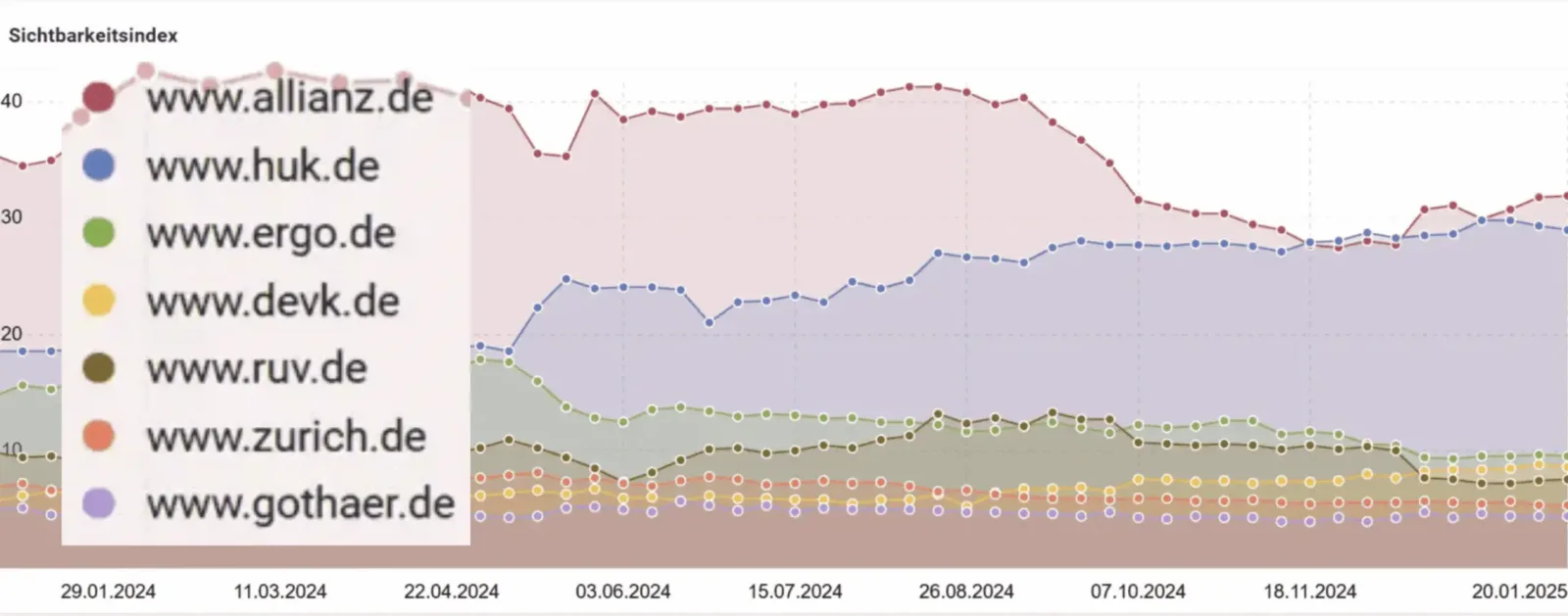
Looking back: Allianz held the SEO lead, but 2024 was anything but a relaxed run at the top.

In the fourth quarter, Allianz lost around a third of its visibility. Before year-end, it showed resilience and recovered strongly in December.

HUK held second place almost all year, but trailed Allianz by a wide margin until mid-year. At the same time, it had to hold off ERGO and R+V.

In the second half of the year, HUK hit the turbo. It pulled away from its chasers and noticeably narrowed the gap to Allianz.

The closest chasers of Allianz, HUK, ERGO and R+V, reshuffled from mid-2024 onward.

ERGO briefly moved ahead of HUK in April. In August, R+V passed ERGO for a moment. A tight field with constant position changes.

While HUK pulled further ahead, ERGO and R+V fell back slightly.

DEVK’s rise stands out. At the start of the year, it hardly played a role among the chasers.

Toward the end of 2024, DEVK seized its chance with a strong final sprint and now competes on equal terms in the upper midfield.

Visibility trend of the top 10 insurers in 2024

Visibility trend 2024 of the top 10 insurance companies
Source: SISTRIX

The visibility trend reveals the central pattern: results-driven use of URLs, a clear information architecture and the right content in the right place decide who wins the top search results.

Allianz and HUK score with optimized structures. Many chasers still have a lot of potential in content, information architecture and other on-page SEO measures.

So the exciting question for 2025 is: who can catch up, and who loses ground?

SEO comparison of the top 10 insurers in absolute numbers

We selected the field based on market share, product range and website visibility.

Accordingly, we chose the insurance companies that perform best on these criteria.

With a different focus or weighting, the top 10 could of course look different. Based on our criteria, the following ranking emerged.

Data collected on December 20, 2024:

Key SEO metrics of the top 10 insurers at a glance

InsurerVIOrganic trafficOrganic traffic valueKeywords (DE)Top 10 keywords (DE)Ranking URLsRef. domains (k)Links (k)Trust FlowCitation Flow
01 Allianz.de 31.422,043,7736,096,423444,464124,0202,2056.397126562
02 Huk.de 29.611,846,5075,778,168296,20262,5813,2523.253046353
03Ergo.de9.29698,1191,606,782378,94361,8213,1313.322,1504245
04DEVK.de8.60324,2851,268,163129,18515,2836091.822186047
05Ruv.de7.77660,081585,518421,17971,8145,1515.932,5306252
06Zurich.de5.54348,887540,852187,12935,7961,8292.173285749
07Gothaer.de4.40251,325609,451114,15414,3321,4202.732206251
08Debeka.de3.19318,981500,914128,8087,9612,0821.816785745
09Generali.de2.97195,923180,894206,69825,6371,4732.81,2105745
10HDI.de2.03144,902266,05383,21711,9231,5191.711234743
Source: digitalagenten analysis based on SISTRIX and Majestic

Disclaimer: Data quality is decisive for any benchmark. We used SISTRIX for on-page data and Majestic for off-page data. More on the tools in the FAQ.

What this benchmark cannot offer: the competitors’ own data, for example from their internal web analytics tools. Those values would be far more precise, but we do not have access to them.

Rankings, visibility and organic traffic

The visibility index (VI) shows how visible a website is in search engines. A high VI means the site appears more often in top positions for relevant queries.

The organic traffic value shows what the organic traffic would cost if it had to be bought as Google Ads. The higher the value, the more economical the SEO tends to be.

Organic traffic is the number of visitors who reach a website through unpaid search results.

It is generated only by search engine visibility and the click-through rate (CTR) from the SERPs to the landing page. The value is an estimate by the analysis tool SISTRIX. More in our FAQ.

Visibility index, traffic value and organic traffic of the top 10 insurers

URLVIOrganic traffic value (€ million)Organic traffic
01 Allianz.de 31.426.092,043,773
02 Huk.de 29.615.771,846,507
03Ergo.de9.291.60698,119
04DEVK.de8.601.26324,285
05Ruv.de7.770.58660,081
06Zurich.de5.540.54348,887
07Gothaer.de4.400.60251,325
08Debeka.de3.190.50318,981
09Generali.de2.970.18195,923
10HDI.de2.030.26144,902
Source: digitalagenten analysis based on SISTRIX and Majestic

Keywords and ranking URLs

For insurers, it is essential to appear in search results wherever people look for their insurance products and services.

That means covering a broad, topic-relevant keyword spectrum.

In the end, the pages in the first positions get most of the traffic. Rankings are valuable mainly when they reach the top 10.

The more top 10 rankings relative to all rankings, the more successful the search engine optimization.

Keywords and ranking URLs of the top 10 insurers

InsurerTop 10 keywords DEKeywords DERanking URLsTop 10 share (DE)
01 Allianz.de 124,020444,4642,20527.90 %
02 Huk.de 62,581296,2023,25221.12 %
03 Ergo.de 61,821378,9433,13116.31 %
04 DEVK.de 15,283129,18560911.83 %
05 Ruv.de 71,814421,1795,15117.05 %
06 Zurich.de 35,796187,1291,82919.12 %
07 Gothaer.de 14,332114,1541,42012.55 %
08 Debeka.de 7,961128,8082,0826.18 %
09 Generali.de 25,637206,6981,47312.40 %
10 HDI.de 11,92383,2171,51914.32 %
Source: digitalagenten analysis based on SISTRIX and Majestic

The number of ranking URLs is neither automatically positive nor negative.

What matters is the number of rankings per URL, and with it the clustering of topics and the efficient coverage of keywords.

You can rank poorly with many URLs, and you can earn valuable rankings with only a few.

Backlinks, Trust Flow, Citation Flow and referring domains

Backlinks are links from external websites to your own site. Trust Flow measures the quality of these backlinks, Citation Flow their quantity.

Referring domains show how many different websites link to the site, which reflects the diversity of link sources.

A balanced link profile supports strong rankings. It raises domain authority, and Google reads it as a signal of trust and connectedness.

Absolute off-site metrics of the top 10 insurers

InsurerReferring domains (k)Links (k)Trust FlowCitation Flow
01 Allianz.de 6.397126558
02 Huk.de 3.253046051
03 Ergo.de 3.3221504239
04 DEVK.de 1.822184738
05 Ruv.de 5.9325305950
06 Zurich.de 2.173285446
07 Gothaer.de 2.732206148
08 Debeka.de 1.816785642
09 Generali.de 2.812104842
10 HDI.de 1.711235346
Source: digitalagenten analysis based on SISTRIX and Majestic

Best practices and challenges: benchmarking the top 10 insurers in detail

A race is rarely won by whoever sprints best for a short time. Strategy and stamina matter just as much.

That is why it pays to look beyond the absolute numbers in our tables at ratio metrics for meaningful results.

They explain why each insurer stands where it does, reveal strengths and weaknesses, and allow an outlook on how positions may develop.

The insurance SEO benchmark: download now

For a complete comparison of the most relevant SEO metrics, download the full article with all figures and tables on the top 10 insurers for free:

Efficient information architecture for visibility and traffic

When it comes to smart information architecture and effective, SEO-optimized content, the picture is clear: the current SEO leader Allianz generates around ten times more visibility per URL than the weakest insurers in this category.

Allianz averages a SISTRIX visibility index of 0.0150 per URL.

DEVK follows with 0.014 VI per URL. HUK also uses its URLs comparatively well and keeps the rest of the field at a distance with 0.0091 VI per URL.

Visibility, traffic and rankings per URL of the top 10 insurers

Insurer Visibility (VI) / URLTraffic / URLTop 10 rankings / URL
01 Allianz.de 0.015092756
02 Huk.de 0.009156819
03 Ergo.de 0.002922320
04 DEVK.de 0.014153225
05 Ruv.de 0.001512814
06 Zurich.de 0.003019120
07 Gothaer.de 0.003017710
08 Debeka.de 0.00151534
09 Generali.de 0.002013317
10 HDI.de 0.0013958
Source: digitalagenten analysis based on SISTRIX and Majestic

DEVK is extremely efficient, but runs its promising SEO strategy on a small scale with only 609 URLs.

In absolute numbers, this leads to midfield visibility (8.6 visibility points) and midfield traffic (324,285). With few URLs, DEVK seems to do a lot right.

The challenge for DEVK is to roll out this recipe, proven on a small scale. That means producing more varied content for keywords the target group searches for and embedding it in a broader information architecture.

The success visible in the ratio metrics could be a first explanation for DEVK’s rising visibility in recent months.

Market leader Allianz also dominates organic traffic per URL (927) and top 10 rankings per URL (56).

HUK and DEVK, the direct chasers, reach only slightly more than half of that traffic and trail by more than half in top 10 positions.

Here too, rising chaser DEVK has strong ratio metrics that do not yet show in the absolute numbers, because it lacks breadth and volume.

Catching up through consolidation: bundle, link and target content precisely

The other insurers in our top 10 SEO benchmark have more than enough content. The task is to make it pay off.

Possible measures: merging topically compatible URLs, precise audience targeting and content tailored to search intent.

This also improves user guidance, enables internal links and lets weak content be merged into content pieces that already perform (301 redirects).

An SEO audit shows which URLs qualify for merging, where internal links are missing and whether redirects and indexing work cleanly, ranked by impact.

Duel at the top: rankings and traffic per URL decide first place

After HUK’s chase, the question is whether Allianz can defend its narrow lead or whether HUK will overtake. Allianz still leads in all the on-site metrics above.

In top 10 rankings per URL and SEO traffic per page, Allianz looks almost out of reach.

HUK also needs to catch up on rankings relative to total visibility to overtake Allianz for good. For 2025, most would probably still bet on Allianz.

If HUK improves a little more, that could change soon.

HUK has many URLs with less than 0.1 percent of its total visibility. Finding consolidation options, slimming down and working more efficiently is neither quick nor easy.

Every “weak” URL has to be evaluated for content, then matched with a closely related strong URL, or such a URL has to be created.

Weaker URLs also add up to visibility, which is lost if the merge is not done correctly and consistently. Done right, it pays off.

The fight for visibility is neck and neck, especially in the midfield.

This is where strategic SEO work pays off most: to catch up in 2025, secure a place in the midfield, or even close in on HUK and Allianz again. R+V, for example, briefly overtook HUK in 2024.

Key factors for SEO performance in 2025: URL efficiency, architecture and content quality
Regardless of their position in our top 10, the same key factors apply to all insurers that want to stay successful or maximize visibility in 2025:

  • Consolidate topically related URLs
  • Reduce “weak” URLs by merging or restructuring them
  • Embed lean structures broadly in content and keyword strategies
  • Structure content along the customer journey
  • Use logical internal links
  • Content tailored to the target group and search intent
  • Merge related content pieces into comprehensive URLs
  • Revisit, extend and optimize existing content

A close race in off-page SEO

Among the ten insurers analyzed, most of the race for top positions and visibility in 2025 will likely be decided on-page.

Off-page, however, there are interesting points and opportunities to stand out from the competition and strengthen positioning.

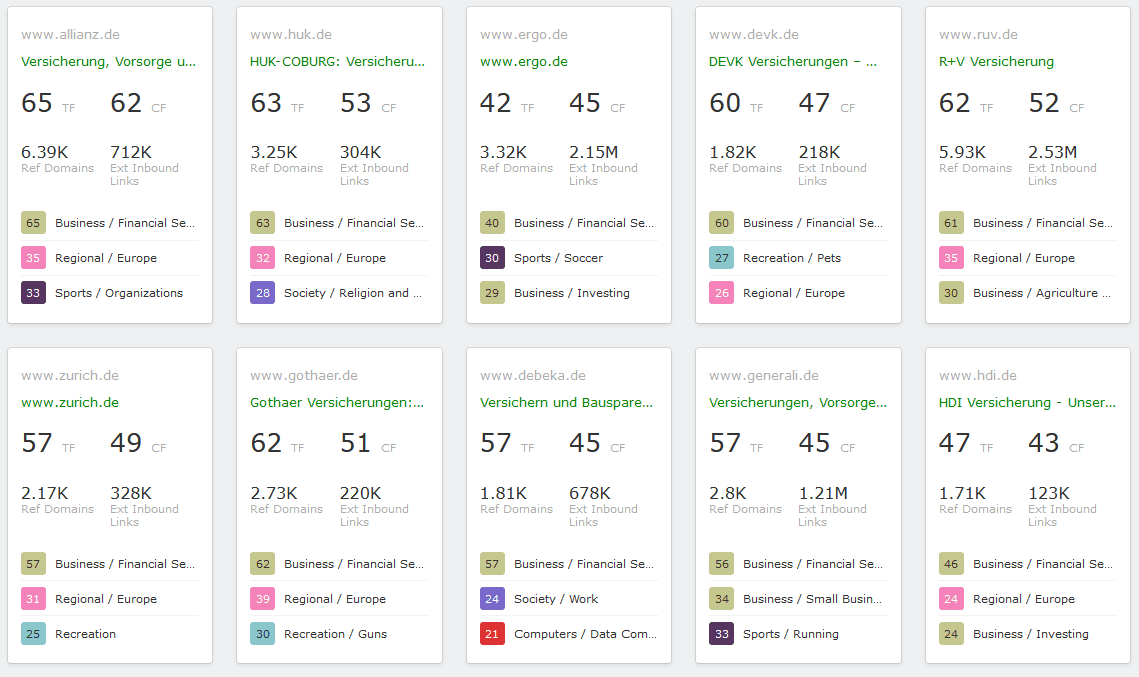
Trust Flow, Citation Flow and backlinks of the top 10 insurers

Trust Flow, Citation Flow and backlinks of the insurance companies
Source: Majestic

In backlinks and off-site metrics, the field is much closer than in on-site metrics. In Majestic’s Trust Flow and Citation Flow, all ten insurers show good to very good values.

Benchmark leader Allianz has the highest brand reach with a Citation Flow of 62.

Its backlink authority is strong as well, reflected in a Trust Flow of 65.

Unlike on-site, the gap to the runners-up is small: HUK (TF 63 / CF 53), R+V (TF 62 / CF 52) and Gothaer (TF 62 / CF 51).

The other top 10 insurers also show solid values. Their brand reach (Citation Flow) sits in the mid to high 40s.

Trust Flow falls below 40 only for HDI and ERGO. Both can gain ground with link building from high-quality sources.

This applies especially to ERGO, the only insurer with a lower Trust Flow than Citation Flow.

Backlink quality and quantity of the top 10 insurers

InsurerReferring domains (k)Links (k)Trust FlowCitation Flow
01 Allianz.de 6.397126558
02 Huk.de 3.253046051
03 Ergo.de 3.3221504239
04 DEVK.de 1.822184738
05 Ruv.de 5.9325305950
06 Zurich.de 2.173285446
07 Gothaer.de 2.732206148
08 Debeka.de 1.816785642
09 Generali.de 2.812104842
10 HDI.de 1.711235346
Source: digitalagenten analysis based on SISTRIX and Majestic

In referring domains and inbound links, R+V leads clearly with 2.53 million inbound links, followed by ERGO with 2.15 million and Generali with 1.21 million.

Allianz, on the other hand, leads the field with more than 6,000 different backlink sources (referring domains).

Overall, Allianz’s success confirms that referring domains matter more than the number of inbound links.

It is better when many different domains give a “recommendation” through a backlink than when a few domains recommend you, possibly several times.

Allianz has fewer inbound links, but many link sources that independently send a quality signal for rankings.

Backlink source diversity: no automatic driver of visibility

HUK, number two in visibility, has an even more diverse link profile than Allianz by this metric, with 93 backlinks per referring domain. But it has only about half as many linking domains.

On paper, Gothaer (81 links per domain) and HDI (72 links per domain) have the most diverse link profiles.

HDI, however, has by far the fewest inbound links and can gain more off-page by improving Trust Flow and Citation Flow.

Diversity alone does not guarantee strong overall SEO performance, but it should never be neglected.

This ratio is not a causal quality factor, but it hints at backlink diversity. Good off-page values are a prerequisite and a catalyst for successful SEO and further growth.

They are the entry ticket to catch up with the best. To actually do so, all other factors must be right as well, above all on-page.

To turn backlinks into more visibility, R+V, Generali and Debeka in particular could use their existing links better. The main levers:

Good off-page values that do not show in overall performance can also indicate untapped potential on-page.

Strong off-site values: a prerequisite for SEO success, but no guarantee

All visibility winners stand out with good to very good off-site values.

In 2025, however, a simple, clear and structured story tailored to the target group will matter more.

Played out across channels and placed in the digital space, content marketing (off-site, for example through PR) earns the backlinks from relevant, diverse and trustworthy domains.

In short: smart off-page SEO opens the door to SEO success, and on-page measures unlock the full potential.

Insurers with room to grow in backlinks can accelerate the success of their on-page work through targeted optimization.

Commercial efficiency: turning SEO performance into money

The monetary value of traffic is calculated from CPCs (cost per click, the price of an ad click for the keyword).

Even more interesting is how much the average visitor would cost in ad spend, or how much value sits in the average URL.

Disclaimer: Visitor numbers and their value are based on estimates, so the method is prone to error. Still, the patterns it reveals are telling.

Traffic value per visitor and per URL of the top 10 insurers

InsurerOrganic trafficOrganic traffic valueRanking URLsTraffic value per visitor (€)*Traffic value per URL (€)
01 Allianz.de 204377360964232,2052.982,764
02 Huk.de 184650757781683,2523.121,776
03 Ergo.de 69811916067823,1312.305,139
04 DEVK.de 32428512681636093.902,082
05 Ruv.de 6600815855185,1510.88113
06 Zurich.de 3488875408521,8291.55295
07 Gothaer.de 251,325609,4511,4202.42429
08 Debeka.de 3189815009142,0821.57240
09 Generali.de 1959231808941,4730.92122
10 HDI.de 1449022660531,5191.83175
Source: digitalagenten analysis based on SISTRIX and Majestic

While the field is close off-site, the metrics differ widely in traffic, traffic value and above all the ratio metrics: traffic value per visit and per URL.

The absolute numbers from SISTRIX confirm the picture so far. Allianz and HUK achieve the highest organic traffic. ERGO and R+V reach around 0.7 million visits each. Allianz still has almost three times as much.

Traffic value per visitor: the euro value shows real SEO performance

Traffic alone tells only half the story. Only by linking traffic and its monetary value (in euros) can you see how much the insurers saved in opportunity costs through SEO.

After all, traffic that did not come organically would have to be bought, for example through Google Ads (SEA).

The surprising result: DEVK reaches a total traffic value of 1.27 million euros with only 609 ranking URLs.

By comparison, benchmark leader Allianz achieves 6.1 million, almost five times as much, but with 2,205 ranking URLs.

DEVK’s average value per URL of 2,100 euros is therefore not far from Allianz at 2,800 euros.

A pure online store usually achieves a much higher euro value per URL and per visit than a publisher.

The reason is obvious: stores compete with other stores for commercially valuable keywords, a competition that drives up the CPC.

Publishers often rely on a broad mass of informational keywords with little commercial value.

This is where it gets exciting: insurers sit between these two extremes. They need commercially valuable keywords to reach transactional goals.

At the same time, their products need explanation, so they also have to target informational keywords to build reach and meet potential customers at their search intent.

The result is a varied content and keyword mix of transactional and informational content, developed along the customer journey.

How well the content fits can be measured with two central metrics: the average organic traffic value per visitor and the average value per URL.

The right content mix lowers opportunity costs

R+V, Zurich, Debeka, Generali and HDI are partly well below two euros per visitor and below 300 euros per URL. This suggests their rankings rely mainly on low-value informational keywords.

The leaders Allianz, HUK, ERGO and DEVK reach much higher values: all are in the four-digit euro range per URL and achieve two to more than three euros per visitor.

These figures point to a stronger focus on commercially valuable keywords and transactional content.

As explained, the sweet spot for insurers lies in the value per visitor and per URL.

The insurers between two and three euros per visitor also lead in visibility, which supports this.

Insurers with low values should analyze their content mix more closely, especially the ratio of guide content to dedicated product pages. Possible optimizations:

A clear focus on transactional keywords brings economic benefits and improves the user experience, because content addresses user needs more precisely.

In the long run, both visibility and the trust of the target group benefit.

Backlink quality and quantity of the top 10 insurers

InsurerReferring domains (k)Links (k)Trust FlowCitation Flow
01 Allianz.de 6.397126558
02 Huk.de 3.253046051
03 Ergo.de 3.3221504239
04 DEVK.de 1.822184738
05 Ruv.de 5.9325305950
06 Zurich.de 2.173285446
07 Gothaer.de 2.732206148
08 Debeka.de 1.816785642
09 Generali.de 2.812104842
10 HDI.de 1.711235346
Source: digitalagenten analysis based on SISTRIX and Majestic

Strengths and potential of the top 10 insurers in our 2025 SEO benchmark

Allianz: the current SEO leader

Strengths:

Potential:

HUK: right on Allianz's heels

Strengths:

Potential:

R+V: lots of content with high practical value

Strengths:

Potential:

DEVK: efficient, but too little breadth

Strengths:

Potential:

ERGO: strong off-site, potential on-site

Strengths:

Potential:

Debeka, Generali, Zurich, Gothaer, HDI: SEO latecomers with big opportunities

Strengths:

Potential:

Conclusion: who is ready to overtake and outperform the competition in SEO?

2024 showed how dynamic and demanding SEO competition in the insurance industry is. Allianz defended its top position again and remains the benchmark for efficiency and reach.

HUK proved that the gap to Allianz can be narrowed significantly. Its impressive progress in on-site optimization was a clear signal to the competition.

Learning from the leaders

The success of Allianz and HUK rests on a clear strategy: the right balance of efficiently used URLs, valuable organic traffic and a targeted focus on commercial keywords.

This interplay gives them a clear lead over the midfield.

For the chasers, this is both the biggest challenge and the biggest opportunity.

They already have enough backlinks and rankings. Targeted on-page optimization can unlock much more.

A focus on building out the information architecture and using URLs more efficiently can help them reach their full potential and keep catching up.

A traffic forecast puts a value on this potential: it shows which traffic and leads additional on-page work can bring and which measures pay off first.

Build on strengths, spot opportunities, use potential

HUK has shown how important targeted optimization is for a successful SEO strategy.

With further improvements, it could become market leader in 2025, or at least put pressure on Allianz and pull further away from the midfield. R+V, ERGO, Debeka, Zurich and Generali also have clear options to climb.

As for DEVK, which recently impressed with efficiency, it remains exciting whether it can scale this approach and continue its upward trend.

The coming months will show who takes the decisive steps to secure a lasting SEO position in 2025.

We welcome feedback, ideas and questions, for example about the search engine optimization of your insurance company and its growth potential.

FAQ on the insurance SEO benchmark

People search, compare and buy insurance online, or book an appointment with a local agent. This applies to new and existing customers alike.

Google still holds more than 90% of the search market in Germany. That is why large insurers constantly race for top rankings and maximum visibility.

Whoever is found for the right search intent at the right moment can use it efficiently for customer acquisition and brand building.

Insurers that make search engine optimization (SEO) an integral part of their online marketing strategy and win top positions get what every sales-driven business wants:

  • More policies and leads (online and offline)
  • Higher visibility and more organic traffic on their own website without ad spend
  • Successful local targeting through SEO for individual locations
  • Product-specific visibility in the target group through keyword optimization
  • Synergies within a holistic content marketing strategy
  • Long-term cost savings through sustainable rankings

SISTRIX: on-page analysis

SISTRIX is particularly suited for:

  • Measuring the visibility index
  • Detailed competitor analysis including keyword rankings and keyword research (search volume, historical rankings and keyword clusters)
  • On-page analysis with technical approaches

The tool reaches its limits in off-site analysis, and in-depth technical SEO issues cannot be captured.

Technical SEO would require a crawler such as Screaming Frog, or Lighthouse or GTmetrix for load time analysis.

Majestic: off-page analysis

For backlinks and off-site SEO, we chose Majestic because of its extensive data:

  • Trust Flow and Citation Flow to assess the quality and quantity of backlinks
  • One of the largest link databases available for precise analysis
  • Historical off-page data to track developments and their impact

In turn, Majestic does not focus on on-page analysis. It lacks advanced keyword metrics, which makes a holistic competitor analysis harder. Together, both tools enable a comprehensive on-site and off-site analysis.

Formula for the visibility index:

The formula differs between tools (SISTRIX, Ahrefs, Semrush and others), so values can only be compared within one tool. In general:

Visibility index = ∑ (keyword position × search volume)

Formula for the organic traffic value:

Organic traffic value = cost per click (CPC) for the keyword × organic traffic

Formula for organic traffic:

Organic traffic = number of unpaid website visits from search engines

The traffic figures estimated by SISTRIX can only be a rough outside estimate.

They are based on all keywords and rankings SISTRIX measured for the insurers and the average position-based click probability for each ranking, which results in an assumed number of visitors.

Higher or lower CTRs, more or less well-known brands and similar factors can make this figure vary considerably.

Seasonal fluctuations in search volume are probably reflected as an annual average.

The estimated traffic can therefore deviate from actual traffic to a greater or lesser extent.

The comparison is still meaningful, because the same assumptions, even if possibly inaccurate, apply to all insurers.

Through the SISTRIX index, the method covers the most searched keywords, including those of the insurance industry.

Off-site metrics in the SEO benchmark: Trust Flow, Citation Flow and referring domains

  • Trust Flow: a Majestic metric that rates the quality of referring backlinks. The higher the Trust Flow, the more valuable and trustworthy the linking domains.
  • Citation Flow: measures the number of backlinks regardless of quality. The more backlinks a website has, the higher its Citation Flow.
  • Referring domains: the number of unique domains with at least one backlink to the target page.
  • Number of links: the total number of inbound links. This metric is debatable, because the absolute number says little. Many links are not automatically good, few links not automatically bad. Quality is what counts.

Historic Index or Fresh Index for backlinks?

For this insurance SEO benchmark, we used Majestic’s Fresh Index. It is better suited to examine current off-site developments from the outside.

The Historic Index is better suited to view the entire accumulated backlink history over decades.

Download now

Insurance SEO benchmark

PDF icon for downloading the study on Google reviews in the insurance industry
Markus Killius

Markus Killius

SEO & Content
Lorenz Wacker

Lorenz Wacker

Managing Partner