GEO & SEO Reporting 2026: KPIs That Convince Budget Owners Despite Zero-Click and AI Overviews
TL;DR
- In 2026, search creates value in two places: traffic to the website and visibility directly in the search results.
- AI Overviews and SERP features answer many questions without a click, so classic SEO reporting is incomplete.
- SEO reporting convinces budget owners again when new KPIs are linked to business value: pipeline, leads, revenue.
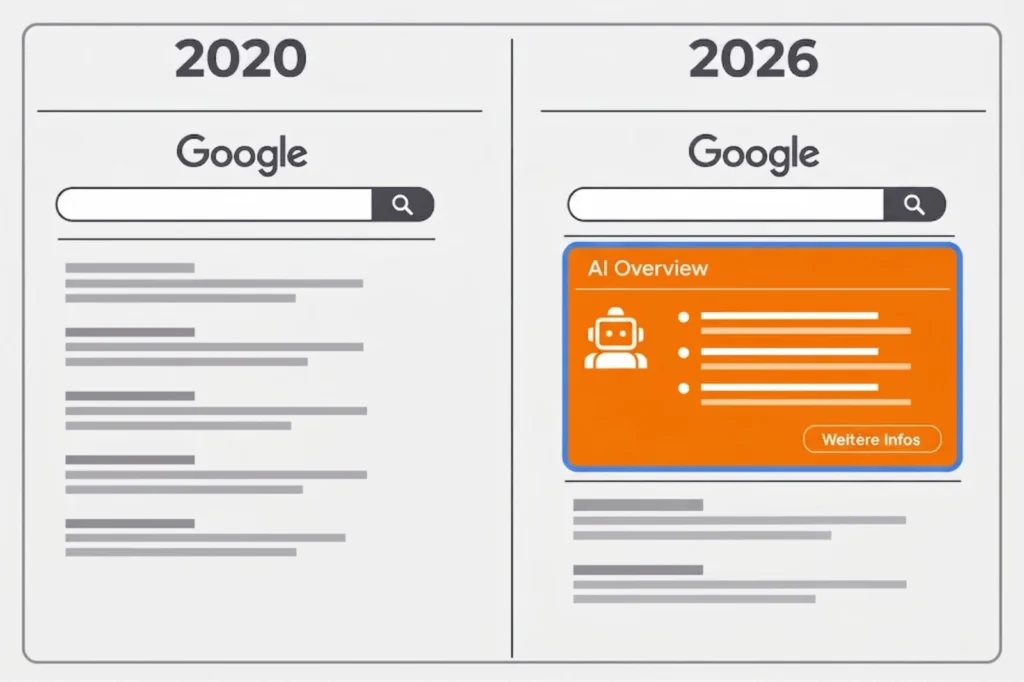
A growing share of informational searches now ends in the search engine itself.
SERP features, local elements and AI Overviews deliver answers, comparisons and next steps without a click to the website.
This shift toward visibility that works before (!) the site visit makes classic SEO reports incomplete. Visibility creates impact today, even if the click does not happen yet.
Reporting becomes reliable for decision-makers again when the new metrics are systematically connected to business value.
Contents
The CTR shift: visibility and traffic only seem to decouple
For years, the click was the only currency in SEO. That is changing fundamentally.
When AI summaries and extended SERP features answer questions directly in the search engine, visibility already creates brand impact, even without a website visit.
A falling click-through rate (CTR) for informational queries is often not a system error. It is simply the new normal.
Clicks are not worthless, on the contrary: for queries with clear purchase intent, they remain essential.
Reliable SEO reporting for decision-makers now requires a strict separation of signals, so cause and effect do not get mixed up:
- Impressions and SERP domination measure market presence.
- CTR and sessions show actual interaction on the website.
- CRM data proves the hard business value in the end.
If you expect one metric to explain the entire customer journey, you are flying blind. Click data stays valuable, especially for offers with clear inquiry or purchase intent.
A clear view of demand and SEO performance only emerges from the overall picture: impressions and visibility show presence, CTR and sessions show website interaction, CRM data shows business value.
Separating the signals prevents one metric from having to explain more than it can. Layered at the right points, they form a reliable overall picture.
The search trends 2026 show how search is split between Google and AI.
3 data points that support the new evaluation logic
The SEO KPIs that really matter in 2026 reporting
A clear view of demand and performance only emerges from business figures, presence and user behavior combined. That is why we group the relevant SEO KPIs into three logical categories:
Business value: the ultimate yardstick for budget owners
Business value translates visibility into hard currency. It answers management’s question directly: “What does this traffic actually bring us?”
Ultimately, it is what arrives measurably in the CRM. It is the most important KPI category because it proves the direct ROI of SEO efforts. Instead of looking at traffic in isolation, we measure:
- Pipeline contribution: what is the monetary value of the opportunities generated or influenced by search?
- Qualified leads (MQLs/SQLs): how many of the generated contacts match the ideal customer profile?
- Win rate and velocity: do search leads turn into paying customers more often and faster than leads from other channels?
Business value is the top of the reporting pyramid and acts as a corrective for all other SEO measures. It only emerges when the two levels below it work:
- The control level (tech and content) ensures that AI and search engines can capture the website without errors.
- The visibility level (SERP domination, rankings and traffic) then attracts users.
- Business value finally proves whether they were the right users. The golden rule: if visibility grows but business value stagnates, you see immediately where to sharpen, based on the individual KPIs.
New KPIs from GEO and AI
To feed business value, visibility has to become measurable in the AI era.
- SERP domination: the measurable share of key SERP elements (classic results, AI Overviews, FAQs, shopping) for a fixed, prioritized set of queries. The report tells a clear story: visibility for the intents that matter to the business.
- AI citation rate: AI Overviews work with sources. This metric measures how often your content appears as a reference in AI answers. Its trend drives the actions: expand reference pages, sharpen terms or strengthen link paths.
- AI share of voice (AI SOV): while the citation rate only counts mentions, AI SOV captures how much space and weight your brand gets in AI answers compared with competitors. Decision-makers see at once whether you dominate the topic or leave it to the competition.
- AI referral traffic: isolates measurable traffic from pure AI answer engines such as Perplexity or ChatGPT Search. It proves in black and white that buyers already research outside the classic Google ecosystem and convert from there.
- Conversion-weighted SERP visibility: prioritizes presence by relevance. A ranking for a query close to leads (for example “software vendor comparison”) gets a higher weight in the score than a purely informational search.
Classic SEO KPIs in a new context
Click data stays valuable, especially for strong purchase intent. In the new SEO report, however, each metric gets a more focused role:
- Rankings and market share: keyword rankings (top 3 / top 10 spread), share of voice (organic market share), classic visibility indices (for example SISTRIX).
- Brand demand (brand searches): a very early performance signal. If searches for your brand combined with expert topics rise, trust is growing.
- Traffic and segmentation: growth becomes manageable only through segmentation: brand vs. non-brand, page type (guide vs. service), user intent (learn, compare, inquire).
- Engagement instead of bounce rate: event tracking shows whether user intents are served (scroll, CTA click, form start, download). These events bridge visibility and later business value in the CRM.
- Backlink profile and authority: referring domains, domain rating/authority, Trust Flow and topical link relevance.
- Tech and UX: Core Web Vitals (load times, layout stability), indexing rate and crawl errors.
- Website performance: organic conversion rate, pages per session and time on site.
Data sources and tools for GEO and SEO reporting
Reliable SEO reporting needs consistent data sets over longer periods. Only then do you get dependable recommendations.
Demand and visibility: Search Console, SISTRIX, Semrush, Ahrefs
For demand and visibility, a few data sources are enough as long as you use them consistently: impressions, clicks, CTR and positions from Google Search Console provide the most stable base signal.
Visibility tools add the trend and enable competitor comparison for prioritized query sets and topic clusters.
Tools: Google Search Console, SISTRIX, Semrush, Ahrefs
Keyword data and budget signals: Keyword Planner, Google Ads, other sources
For a demand analysis, keyword tools deliver two practical building blocks: demand (volume trends) and economic signals (CPC and competition as a rough estimate of traffic value).
For reporting, what counts is a consistent data set over a longer period.
Tools: Google Keyword Planner, Google Ads, Microsoft Advertising
User behavior and conversions: GA4 and server logs
Website data connects visibility with interaction: which pages are used, which steps are triggered, which conversion paths work.
Event tracking makes goal completion visible (scroll, CTA click, form start, inquiry). Server logs add a technical view where needed.
Tools: Google Analytics 4, Matomo
Pipeline and revenue: CRM data (HubSpot, Zoho, Salesforce)
CRM data makes business value reliable: lead source, stage, deal value, win rate, velocity. For reporting, a clear model with fixed variables is enough: which events count as a lead? How are stages defined? How is value mapped in the pipeline?
Tools: HubSpot CRM, Zoho CRM, Salesforce
Tech and internal links: Screaming Frog plus link juicer logic
Crawl data provides the technical basis: indexability, canonicals, status codes, internal link paths, template consistency.
Combined with link juicer rules, a visible logic emerges: which terms link where, and which pages get the strongest internal link flows?
Tools: Screaming Frog, Sitebulb
Links and authority: Majestic, Ahrefs, Semrush
Link data serves as context: topical fit, trust signals, relevant referring domains. For reporting, quantity matters less than classification by relevance and quality.
Tools: Majestic, Ahrefs Backlink Index, Semrush Backlinks
The KPI tree: from tool stack to strategic SEO dashboard
A tool stack alone does not produce decisions. The KPI tree bundles the collected data on three clearly separated levels and creates a crystal-clear decision logic for management.
Level 1: business value (anchor the management goal in the CRM)
The ideal setup starts in your CRM:
- Define lifecycle stages clearly: a visitor is not a lead. Tracking needs hard definitions (lead → MQL/qualified → opportunity → won).
- Master attribution and touchpoints: consistently capture “sourced” (search was the first contact) and “influenced” (search was a touchpoint in the journey) through complete UTM tracking and clean field mapping.
Level 2: visibility (prioritize the marketing lever)
Here we measure how strong demand for our topics is in the market. Perfection means segmentation:
- Query sets by user intent: cluster queries strictly by intent and map them to your money pages.
- Measure SERP domination: define which SERP elements count for your sets. Are you cited in the relevant AI Overview? Do you own the featured snippet?
- GA4 event model: build event tracking that measures real interaction (for example CTA clicks, contact paths, form starts).
Level 3: control (secure the operational SEO foundation)
When numbers drop on level 1 or 2, level 3 provides the operational levers for the implementation team:
- Indexability as gatekeeper: the dashboard needs red flags for critical status codes, faulty canonicals and load-time drops.
- Content and internal links as a system: monitor complete topic coverage in your clusters. A good setup shows which pages get the strongest internal link flow.
- Data quality as routine: tracking outages or faulty consent ruin any report. Automated alerts protect data integrity.
The ideal SEO reporting routine: standardize monitoring
A KPI tree lives from clear responsibilities (tech vs. SEO vs. CRM):
- Weekly (operational): quick check of indexability, technical errors and pure visibility (query sets).
- Monthly (strategic): scorecards for management, focused on business value, pipeline growth and the trend of GEO metrics.
- Quarterly (development): update routine for reference pages, topic clusters and strategic realignment.
After an SEO audit, monthly monitoring makes every step of progress visible.
Multi-location businesses: local control, network-wide synergies
For companies with several branches, franchisees or local sales territories, a one-dimensional KPI tree is not enough. Central brand management and decentralized lead generation collide here.
The ideal setup combines tracking across the entire domain with strictly location-based control to unlock maximum synergies:
- Roll-up and drill-down dashboards: management needs the aggregate (total business value and national brand visibility). The local sales or branch manager only needs local query sets and location leads in the CRM. A modular dashboard solves this.
- Measure local SERP domination: visibility is weighted very differently at the local level. Presence in the Google local pack (Google Business Profile) or on Google Maps for searches like “service + city” is the biggest lever and must be evaluated separately from national guide rankings.
- Synergies at the control level: the dashboard shows how the strong central domain passes authority to local landing pages, and how national informational traffic is steered to local transactional pages through smart internal linking.
- Location attribution in the CRM: business value on level 1 gets the parameter “location/region”. Budget owners see at a glance which sales areas are underserved digitally and where local budget shifts turn into revenue fastest.
An opportunity analysis calculates this in advance: it shows per location and channel how much demand remains unused and which budget shift returns the most revenue.
From theory to practice: your tailored SEO dashboard
Setting up modern GEO and SEO reporting takes time at first, but then saves endless discussions and delivers valuable data.
If you want to check how this KPI tree fits your business goals, CRM systems and tracking needs, we are happy to support you.
Together we build a dashboard that makes monitoring easier, automates data flows and turns data silos into real strategic insights. Book a free, no-obligation consultation now.
FAQ on GEO and SEO reporting
Which KPIs show the business value of SEO most clearly?
CRM-related metrics provide the clearest basis: pipeline contribution (directly attributed and assisted) and, where available, revenue contribution. Conversion-weighted visibility adds which queries and topics create value.
How can you measure AI and LLM visibility without focusing on clicks?
SERP domination and the AI citation rate show visibility as presence in important queries. A constant set of prioritized queries ensures comparability over time.
A GEO readiness audit provides the baseline for this AI visibility.
Which classic KPIs remain essential for steering SEO?
Impressions, rankings, CTR, sessions, internal link paths, indexability and engagement events together form a stable control picture. Segmenting by user intent makes these signals more precise.
Which data sources are enough for a clean setup?
Google Search Console, GA4 (events) and the CRM are enough as a core. Visibility tools and crawl data add competitor comparison and technical control.
How do you build a robust connection between GA4 and the CRM?
A clear event model, consistent UTMs and defined lifecycle stages connect interaction with the pipeline. This makes value metrics reliable without complex modeling jargon.
Conclusion: reporting that explains business value and visibility at the same time
A KPI system with three roles stays stable in reviews: business value in the CRM, visibility in prioritized queries, control via tech, content and internal links. This creates a pragmatic basis for decisions and priorities.

Natalie Hufeland
Senior SEO Manager
Natalie Hufeland is an SEO and project manager specializing in local optimization, giving clients with one or thousands of locations a local visibility advantage.
Online Marketing Agency Berlin » Digital Marketing Blog » GEO & SEO Reporting 2026: KPIs That Convince Budget Owners Despite Zero-Click and AI Overviews